


As of this writing, the County Council is set to hold a hearing tomorrow night, September 21st at 6 PM at the Arundel Center, on Bill 61-26, a 239-page rewrite of Article 18, the county’s zoning code. This is the first comprehensive overhaul of Article 18 since 2005, requested by Wealthy Horseman and County Executive Steuart Pittman and sponsored by Council Chair Julie Hummer, and it touches 341 separate provisions. Most of it is the kind of housekeeping nobody will ever read: renumbered sections, cleaned-up definitions, parking ratios for assisted living facilities. But buried in there is a brand new set of rules for food trucks, and it’s worth a closer look before tomorrow night, because the county didn’t tweak an existing ordinance. It wrote one from scratch, and it wrote a bad one.
Here’s what should bother you regardless of where you land on food trucks generally: Anne Arundel County currently has no zoning category for them at all. None. A food truck operating in this county today does so in a regulatory void, defined by nothing, restricted by nothing in Article 18. That means the county had a blank slate to work with. It could have written something permissive, something neutral, something that just formalized what’s already happening at breweries and farmers markets and church parking lots across the county. Instead, it wrote this, as new Section 18-10-139:
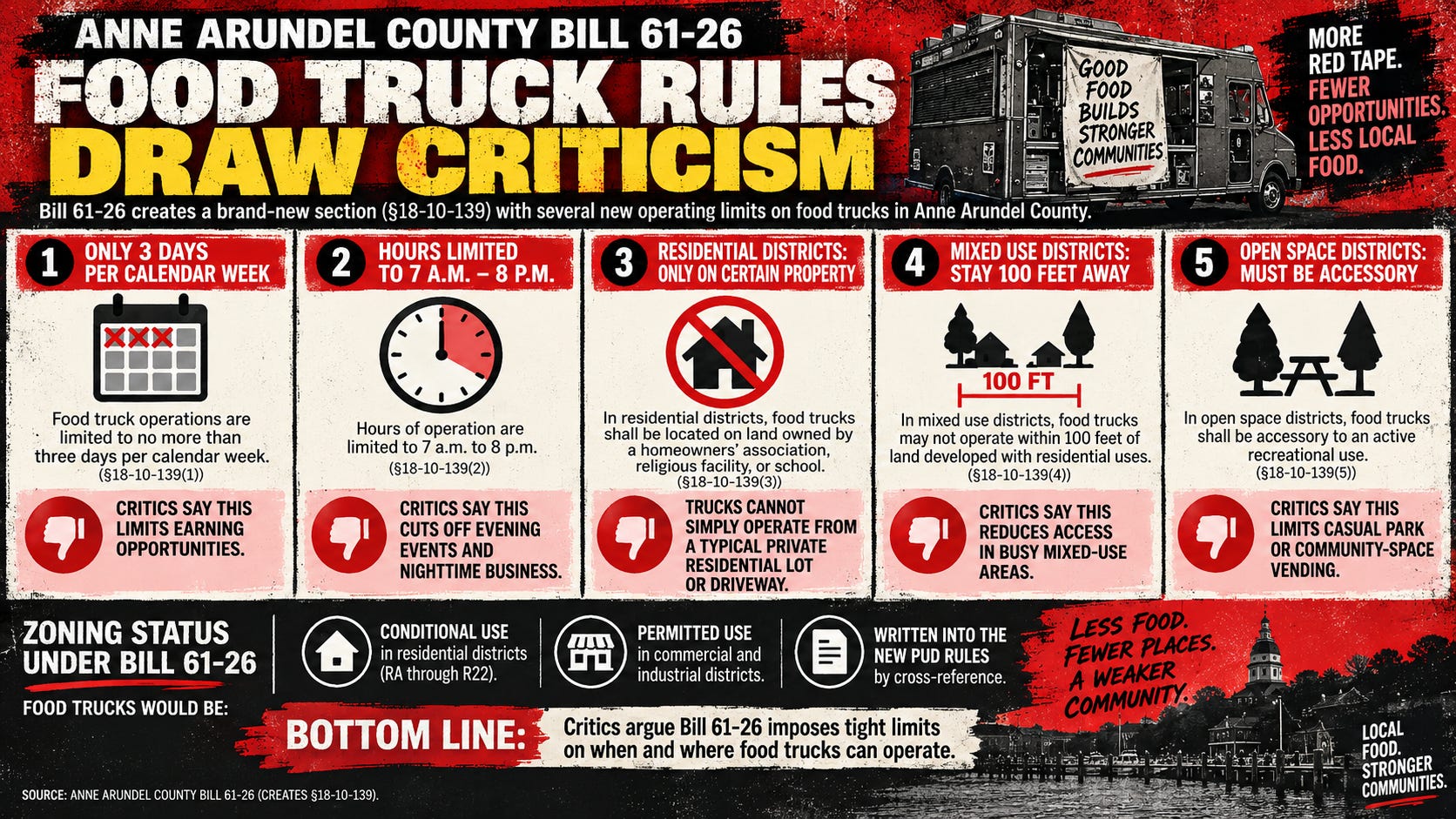
A food truck shall comply with the following requirements. (1) Food truck operations are limited to no more than three days per calendar week. (2) Hours of operation are limited to 7 a.m. to 8 p.m. (3) In residential districts, food trucks shall be located on land that is owned by a homeowner’s association, religious facility, or school. (4) In mixed use districts, food trucks may not operate within 100 feet of land developed with residential uses. (5) In open space districts, food trucks shall be accessory to an active recreational use.
Take that third provision for a second, because it’s the one that actually matters for most people reading this. If you live in a residential district (that’s RA through R22, meaning essentially every subdivision in the county), a food truck cannot legally set up unless the land under it is owned by a homeowner’s association, a church, or a school. Your own driveway doesn’t count (unless, one assumes, it’s been quietly annexed by a homeowner’s association, in which case my condolences). A neighbor’s cul-de-sac block party doesn’t count. The taco truck a homeowner wants to hire for a graduation party in their own backyard is, under this bill, not a permitted use of that homeowner’s own residentially zoned property. It’s only fine if the HOA owns the land it’s parked on, which in practice means the county has decided food trucks are acceptable in a common area clubhouse lot, but not on the property of the person actually paying for the truck.
That’s insane.
The three-day and hours restrictions are their own separate problem. Three days per calendar week, 7 AM to 8 PM, full stop, no matter the district. That’s not a noise ordinance or a nuisance standard tied to actual complaints. It’s an arbitrary cap written into the underlying zoning code itself, the same document that governs whether you can build a garage. A food truck that wants to run five days a week because that’s what the business actually requires to be viable is simply out of luck, permanently, unless it can somehow argue its way into a special exception process that wasn’t built for this. Compare that to the mixed-use district rule, which at least gestures at a rationale (the 100-foot residential buffer), and the difference becomes obvious. The residential and hours provisions aren’t solving a documented problem. They’re just restrictions for the sake of having restrictions, dropped into a use category that, again, didn’t exist a year ago. It will put make county food truck business owners, thriving with five-day-per-week operations, either cut back their hours and lose income or relocate their business out of county at least two days per week in order to avoid petty regulations.
What makes this stranger is what the rest of the same bill does to home-based businesses running out of actual houses. While food trucks get locked into a three-day, sunrise-to-8pm cage, the county’s own list of proposed amendments shows Bill 61-26 expanding the list of businesses allowed to operate as home occupations, adding locksmiths, personal fitness studios, tanning salons, and travel agencies to what’s already permitted, while stripping out an old restriction that barred home businesses from selling goods they didn’t make on-site. (The one new home-occupation restriction actually worth taking seriously: no training attack dogs or police K9s out of your house. A reasonable rule. Somehow the more reasonable rule is the one getting less attention.) So the same rewrite that treats a taco truck parked in a church lot on a Tuesday afternoon as a zoning emergency is simultaneously telling you it’s fine to run a tanning salon out of your basement seven days a week. Nobody in the Office of Planning and Zoning seems to have noticed the tension there, or if they did, they didn’t think it was worth explaining.
None of this happened by accident. Somebody in the Office of Planning and Zoning drafted Section 18-10-139 with these specific numbers, and the County Council is the body that gets to decide tomorrow night whether they stay in the bill or get stripped out before final passage. If you think a three-day cap and an HOA-land-only rule for residential districts is a reasonable way to regulate an industry that’s operated in this county for years without any zoning rules whatsoever, fine, that’s a position you can hold. But it’s worth asking the Council directly why the first attempt at regulating food trucks in Anne Arundel County history landed on rules this restrictive, for a use with this little actual track record of causing problems.
Food truck overregulation is the perfect coda to Steuart Pittman’s eight years in Annapolis; overregulating private businesses while continuing to ensure donors, environmental groups, and developers get theirs.