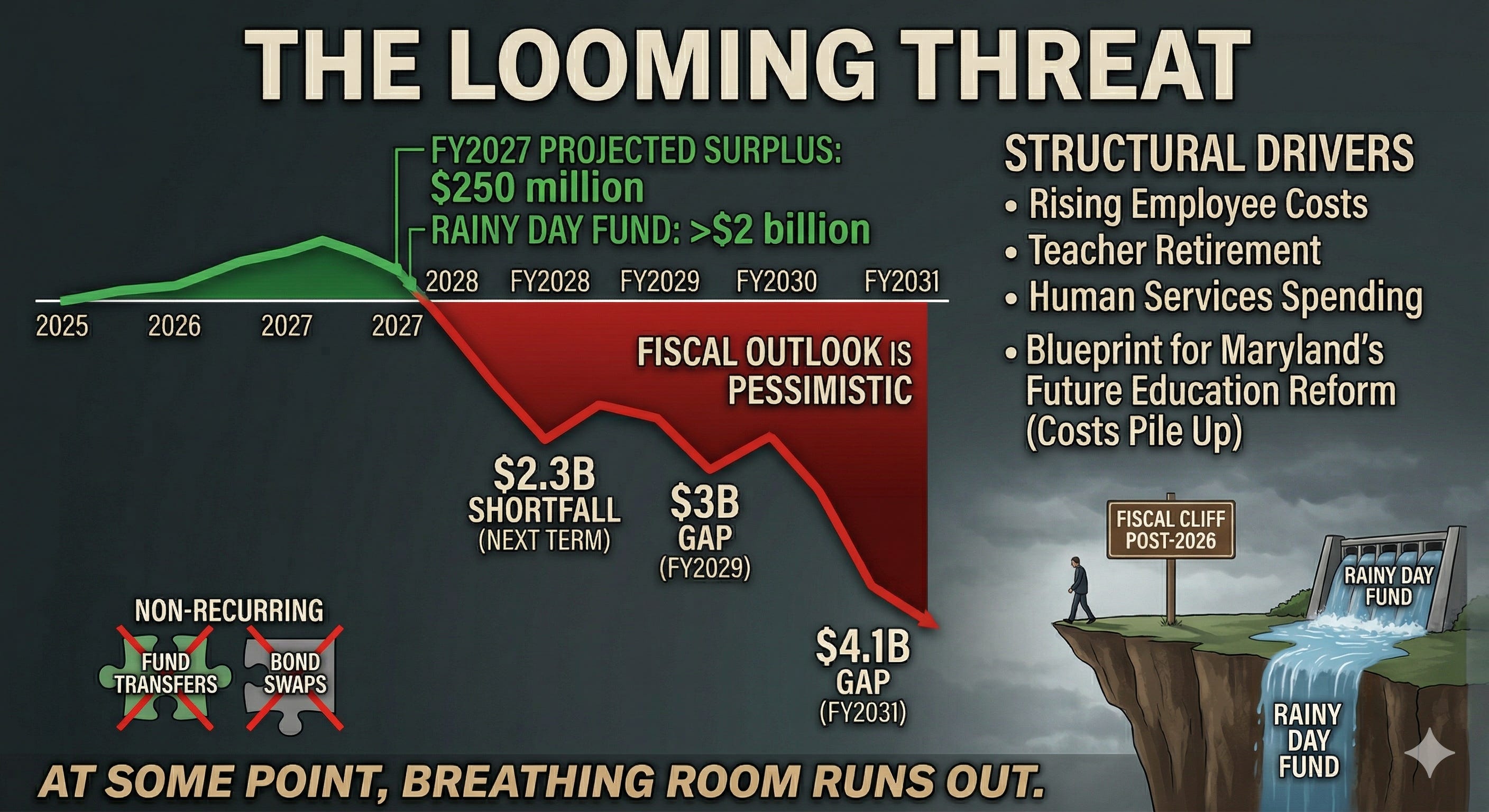
Budget Leaves Looming Threat
“We didn’t raise taxes this year” is not a plan. It’s a posture from Maryland Democrats who have stuck their heads in the sand concerning Maryland’s spending excesses for over twenty years.
Last week, the Maryland General Assembly sent Governor Wes Moore a nearly $71 billion budget for fiscal year 2027. The budget, as adopted, closes a $1.5 billion projected deficit without raising taxes or fees.1 Democrats celebrated. Republicans (correctly) grumbled. And the Department of Legislative Services quietly noted that the gap waiting on the other side of the 2026 election is larger than the one just closed.
That Wes Moore closed the shortfall without new taxes or fees, relying instead on a series of transfers from dedicated funding sources and swapping bonds for cash, is a return to the budget sleight-of-hand we experienced for eight years from Martin O’Malley. For a budget process that last year required $1.6 billion in new taxes and the biggest spending cuts in nearly two decades, this year’s version was comparatively painless. The final vote wasn’t even close: 38 Senate Democrats in favor, six Republicans opposed, and 102 House Democrats to 13 Republicans. It moved faster than any budget since the pandemic-shortened 2020 session.
The problem, as anyone who has followed Maryland’s fiscal trajectory here and elsewhere knows, is what comes next.
The FY2027 budget leaves a projected $250 million surplus and keeps the rainy day fund above $2 billion. But the outlook over the next four years is, in the words of state fiscal analysts, “pessimistic.” The General Assembly and the next governor2 will have to contend with a $2.3 billion shortfall in the next term, a gap projected to widen to approximately $3 billion in FY2029 and $4.1 billion by FY2031. The fund transfers and bond swaps that made this year’s budget work don’t recur. You can raid a dedicated account once.
The structural drivers aren’t going away. Rising employee salaries and benefits, teacher retirement costs, and human services spending are all baked into the out-year projections. The Blueprint for Maryland’s Future, the decade-long education reform plan that Democrats have treated as untouchable, keeps adding cost pressure.3 And that’s before accounting for potential Medicaid cuts from Washington, or the still-unresolved liability from Child Victims Act claims filed against the state.4
Democrats can argue that this year’s budget was always going to be about managing the immediate hole without making things worse. But “we didn’t raise taxes this year” is not a structural fiscal plan. It’s a posture from a party that has stuck its head in the sand concerning Maryland’s spending excesses for over twenty years.
On the surface, the state’s books look better today than they did in January. They look considerably worse than anyone in Annapolis wants to publicly discuss, especially when you run the numbers out to 2030. Leadership has bought itself a year of breathing room.
Sooner rather than later, that breathing room will run out.
After all, it IS an election year.
Presumably Wes Moore, but he’ll be too distracted running for President to notice.
As LITERALLY everybody said it would.
The Child Victims Act created liability that state analysts have called potentially catastrophic. Roughly 12,000 claims have been filed against the state, each carrying a potential maximum liability of $890,000. The math is left as an exercise for you, the reader.