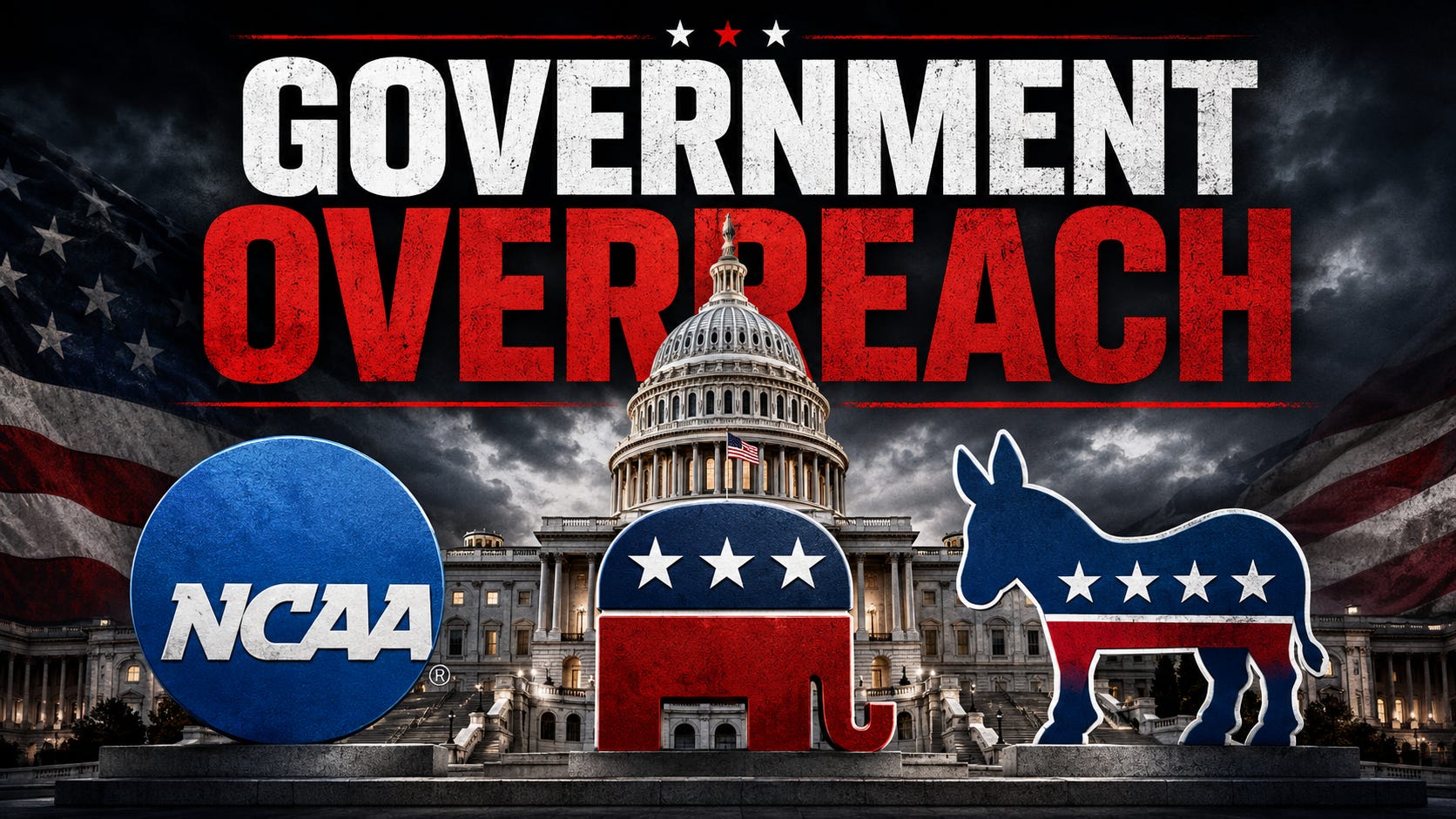
Congress Looks to Micromanage College Sports
Inflation, Government Funding, and the Iran War had to wait while Congress focused on the transfer portal. Because priorities.
The Senate could vote this week on the Protect College Sports Act of 2026. The bill cleared Senate Commerce 19-9 back on June 18, a comfortable bipartisan margin, and after weeks of further revisions Eric Schmitt says he believes it now has the 60 votes needed to pass. Tommy Tuberville doesn’t think so, and took to the floor to say the bill “goes too far.” Nick Saban showed up to testify at the committee stage, because of course he did, in his capacity as co-chair of a presidential commission on college sports.1 Depending on who you ask, this is either the most serious attempt in six years to bring order to a sport that’s been in free fall since Alston, or it is Congress deciding that transfer portal rules are a more pressing use of floor time than, say, the actual state of the country. The Senate breaks for a month-long recess on August 10, so whatever momentum this has, it either clears the chamber in the next two and a half weeks or it waits until fall.
The bill would establish the first real federal framework for college athletics: a national NIL standard that preempts the state-by-state patchwork, a five-year eligibility clock starting at 19 or high school graduation, one free transfer before an athlete has to sit out a year, agent fees capped at 5%, a private right of action letting athletes sue schools directly, and an antitrust carve-out letting conferences pool media rights the way the NFL does. Backers say that last piece alone could generate $4 to $8 billion, some of it earmarked for women’s and Olympic sports. None of that is nothing. Some of it is even good policy.
But the real question is: Why?
Look at what else is sitting on the Senate’s plate right now. Inflation hasn’t gone away just because headline numbers occasionally cooperate for a news cycle. The House just voted 220-205 to extend government funding through December 4, with hard-liners holding the whole thing hostage to a voter-ID bill that has nothing to do with keeping the lights on. The Iran situation isn’t a fading story that needs a reminder footnote anymore. US strikes continue Iranian officials and state-aligned analysts are openly discussing a ground incursion into Kuwait to seize American bases and take US troops hostage, and Trump is reportedly expected to decide within days whether to authorize an American ground operation into Iran itself.2 Against that backdrop, the Senate found the bandwidth to finalize a bill regulating football coaching transitions and agent registration fees, timed for a floor vote before recess. Forty-plus college sports bills have been introduced over the last six years. None of them reached a floor vote until now.3 Maybe that tells you something about the priorities in Congress
The overreach argument isn’t just about timing, though the timing is bad enough on its own. It’s about what kind of thing Congress is regulating . This is a bill that tells schools how many transfers an athlete gets, how football programs handle mid-season coaching changes, and what percentage an agent can charge. Imagine Congress deciding in the 1960s that the American League and National League couldn’t merge business operations, or telling the NBA how to run its draft lottery.4 That’s roughly the level of granularity on display, applied to an entity, the NCAA, that isn’t a public utility or a regulated industry in any normal sense. It’s a private association that ran itself into a legal and financial ditch, and Congress has apparently decided the fix is to run it themselves, one transfer-portal rule at a time.
Of course, it doesn’t resolve the one question that actually needs resolving:are student-athletes employees, with collective bargaining rights and access to labor protections? Senator Maria Cantwell has said publicly that question remains open for future debate.5 So Congress is prepared to write detailed federal statute on agent fee caps and coaching contracts, but not on the single issue that determines whether this whole system gets restructured from the ground up. That’s not stabilizing college sports. That’s picking the easy fights and leaving the hard one for later, again.
The opposition lineup is its own tell. The SEC and Big Ten, the two richest conferences in the sport, are fighting the bill hard, mostly over what it does to their media rights leverage. Player advocacy groups are fighting it too, because they think it locks in a worse deal than what athletes have been winning in court. When the richest conferences in America and the advocates for the athletes they employ in everything but name both think this bill is bad, that’s not evidence of a careful compromise. That’s evidence that nobody’s actual problem got solved, and everybody just got something to complain about.
None of this means the underlying mess isn’t real. Post-Alston, post-House settlement, college sports genuinely is a patchwork of conflicting state laws and ad hoc litigation, and somebody with a claim to represent the public interest in not having that patchwork isn’t crazy to want a federal floor under it. Some of what’s in this bill, the NIL disclosure rules, the medical coverage requirements, the scholarship protections, are decent ideas on their own merits. But “somebody should fix this” is not the same as “Congress should fix this, this month, ahead of the spending fights and the Iran situation.” The NCAA broke itself. That doesn’t make it Congress’s job to put it back together, especially not while everything else on the docket is sitting there waiting.
Congress is on track to cap agent fees and set eligibility windows for college quarterbacks before its August recess. It has not found the same urgency for keeping the government funded past a stopgap, or for getting ahead of a war that’s now openly discussed in terms of ground troops and hostages. That’s not a both-sides observation. That’s a choice the Senate is making this week, and it’s worth remembering who made it the next time somebody tells you Washington doesn’t have time for the basics.
Saban's appointment to a presidential commission on college sports is one of those facts that doesn't need editorializing.
This is the same forever-war trajectory covered here last month. If anything, the last few weeks have made that read look generous
Six years, forty-plus bills, zero floor votes, until this one. Make of Congress's productivity what you will.
To be fair, MLB does have its Antitrust Exemption. But that was not explicitly administered by Congress, but Federal Baseball Club v. National League found that baseball was exempt from the Sherman Act.
Which is a polite way of saying: “we didn't solve it, we just didn't want to admit that out loud during markup”