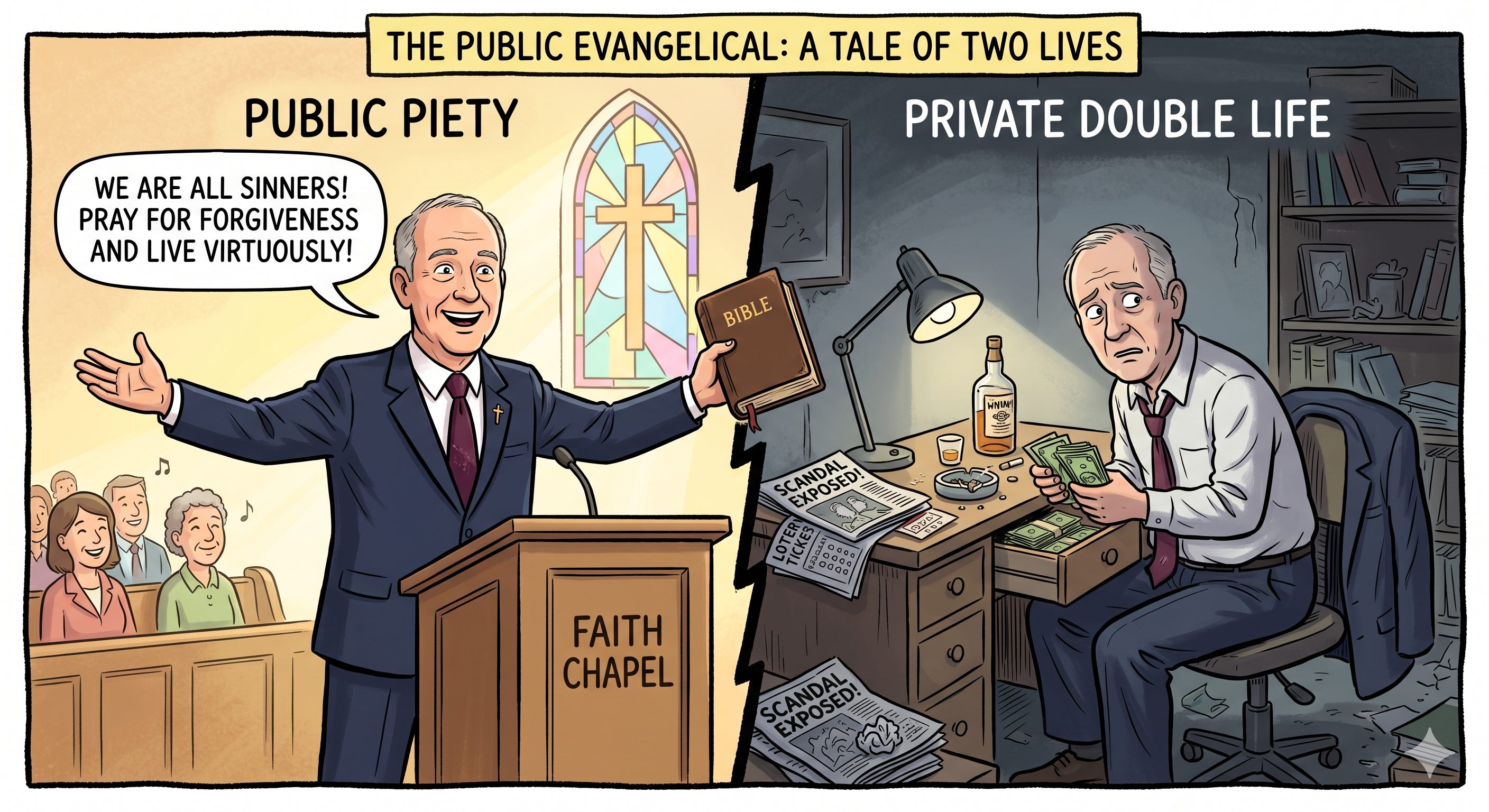
Evangelicalism vs Christianity
"God Will Take Good Care of You, Just Do as I Say Not As I Do"
Back in 2003, I served on the board of the North County Republican Club here in Anne Arundel County, Maryland, as Vice-President. At a Board of Directors meeting, Faith Louodon (longtime activist and ineffective Central Committee member) was speaking about a Republican candidate for Judge, Paul Goetzke. Goetzke was paralyzed from the waist down. Loudon, an evangelical who spoke openly about her faith, stated as a matter of fact that Goetzke was “paralyzed while swimming at Kathleen Kennedy Townsend’s house” as if that minimized his injury and made him “less Republican.”
That was a rude awakening to evangelicals in the Republican Party. And as a 20-something non-Church activist, I was appalled. As a 40-something Catholic convert, I’m even more so.1
Evangelicals long have a history of “do as I say, do not do as I do”, both inside and outside of public life:
Jimmy Swaggart: The loudest voice condemning sin in the 1980s. He was caught with a prostitute in a New Orleans hotel in 1988, but his tearful televised confession kept his $12 million-a-year, 10,000-employee religious empire together until he was linked to another prostitute in 1991. His tearful on-camera breakdown became one of the most famous moments in televangelist history precisely because of how hard he had leaned into moral condemnation of others.
Jim Bakker: He and his wife Tammy Faye turned their PTL (Praise the Lord) ministry into a money-gobbling empire. They sold fake “lifetime vacations” to a Christian theme park and raked in millions. Then it all came crashing down when Bakker got caught paying hush money to cover up sex with a church secretary. Notably, Swaggart was among Bakker’s loudest critics.
Kenneth Copeland: Copeland is the purest expression of evangelical “prosperity gospel” hypocrisy alive today. Copeland has amassed significant wealth and has referred to himself as a “very wealthy man.” His use of private jets, luxury cars, and lavish houses has been widely criticized, with John Oliver noting that the Copelands used tax laws to live in a $6.3 million mansion and used church donations to buy a $20 million jet used for trips to a ski resort and a private game ranch. Copeland once stated he can’t fly on commercial flights because they are “long tubes filled with a bunch of demons.” He preaches that God’s favor is expressed through financial blessing, and that followers should give money to ministries to unlock that favor. Naturally, Copeland’s own financial records are not publicly available.
Joel Osteen: The smiling face of aspirational Christianity. In 2017, Osteen received heavy criticism for initially refusing to open his 17,000-capacity megachurch to evacuees during Hurricane Harvey, a stunning moment for a pastor whose brand is God’s abundance and neighborly love. He owns a Gulfstream G650, a luxury aircraft valued at tens of millions of dollars, which has been a source of considerable controversy given his position as a prominent pastor.
Ted Haggard: By 2006, Haggard had more than 14,000 regular followers at his New Life Church and was president of the National Association of Evangelicals, a position that allowed him to visit the White House repeatedly. That was also the year it came out that he was visiting a gay prostitute who also provided him with crystal meth. He had been a vocal opponent of same-sex marriage.
Creflo Dollar: An Atlanta megachurch pastor and prosperity gospel peer of Copeland and Osteen, Dollar was arrested in 2012 after his teenage daughter alleged he choked her. Dollar denied the charges, which were later dropped. He later became famous for asking his congregation to crowdfund a $65 million private jet.
Benny Hinn: Joel Osteen’s uncle-in-law and one of the most prominent faith healing evangelists of the modern era. His own nephew, Costi Hinn, later wrote about growing up inside the prosperity gospel machine, describing wealthy preachers like Copeland, Dollar, Osteen, and Hinn as living “like rock stars in multimillion-dollar mansions, driving luxury cars, flying in private jets,” all using donations from faithful followers.
Hypocritical evangelical preachers are such a trope that Genesis wrote a song about it over 30 years ago.
There are plenty of politicians who have traveled the same tawdry path.
Newt Gingrich (R-GA, Speaker of the House): Gingrich Led the charge to impeach Bill Clinton over the Lewinsky affair on grounds of presidential character and moral fitness for office. Simultaneously conducting his own extramarital affair with a House staffer 23 years his junior. Gingrich cheated on both his first and second wives, and married both women with whom he had affairs. He has presented himself throughout his career as a defender of Christian civilization and traditional marriage.
David Vitter (R-LA, U.S. Senator) One of the Senate’s loudest voices for traditional marriage and sexual morality. Vitter used a notorious DC escort service at least five times as a U.S. Representative while still married and after having spent most of his political career touting the importance of traditional “family values.” His name turned up in the “DC Madam” phone records, and he admitted to a “serious sin.” He remained in the Senate and won reelection.
Mark Foley (R-FL, U.S. Representative) Former Florida Representative Mark Foley was well known for leading the House caucus on missing and exploited children and fighting for harsher penalties for sexual predators. He resigned in 2006 after sexually explicit messages he sent to underage Congressional pages came to light. The people he targeted were minors. He had been a reliable vote against gay rights throughout his career.
Larry Craig (R-ID, U.S. Senator): A member of the Senate’s family values caucus and consistent opponent of gay rights. In 2007, Senator Larry Craig pleaded guilty to disorderly conduct after an undercover police officer accused him of soliciting sex in a men’s restroom at the Minneapolis airport. After getting caught, eight men came forward alleging they either had sex with him or were targets of his sexual advances.
Ed Schrock (R-VA, U.S. Representative): Schrock announced he would terminate his 2004 campaign for a third term after allegedly being caught on tape soliciting sex with men, despite having aggressively opposed various gay-rights issues in Congress, including same-sex marriage and gays in the military.
Wes Goodman (R-OH, State Representative): A newer entry, but one of the clearest examples. Goodman built his career explicitly on evangelical Christian identity and “natural marriage.” The nation’s leading anti-gay marriage organization, Citizens for Community Values, was among the Christian conservative groups that knew of Goodman’s extramarital sexual contact with other men before his election. The Council for National Policy also handled internally a complaint that Goodman fondled an 18-year-old college student while he was sleeping. Tony Perkins of the Family Research Council was personally informed of the complaint and chose to handle it quietly. Goodman resigned in 2017 after being caught in a sexual encounter with a man in his state capitol office.
Robert Bauman (R-MD, U.S. Representative): An early and particularly stark example, Bauman was an outspoken “family values” proponent and president of the American Conservative Union. He was arrested after soliciting a sixteen-year-old male, and sponsored the anti-gay Family Protection Act while loudly supporting legislation denying certain privileges to gay and lesbian veterans.
Roy Moore (R-AL): Alabama’s most famous evangelical culture warrior, Moore was famous for installing a Ten Commandments monument in a courthouse and for multiple failed Senate and gubernatorial runs. Credible reporting from multiple women described him pursuing relationships with teenage girls when he was in his 30s. The evangelical community’s response to Moore’s accusers highlighted what critics describe as selective morality, with some evangelical leaders defending Moore by drawing comparisons to biblical figures.
Trump's apotheosis is the natural progression of evangelicalism in politics. Scandal was the end for a preacher like Swagger or Baker, and for politicians like Foley, Craig, and Bauman. But for reasons that defy logic, Trump remains the darling of the evangelical right, despite believing nothing that evangelicals believe in or really promoting issues evangelicals campaign for.
“The Access Hollywood Tape” did not erode evangelical support for Trump.
The hush money paid to Stormy Daniels did not erode evangelical support for Trump.
The Bible Photo Op in 2020 did not erode evangelical support for Trump.
Telling reporters that he did not think he needed to ask for forgiveness did not erode evangelical support for Trump.
Trump’s laissez-faire attitude on abortion, in pushing it to the states or voicing his support to remove the Hyde Amendment, did not erode evangelical support for Trump.
No, institutional evangelicalism gave consistent air cover to Trump to keep its connection to power and influence in the Trump Administration and in the Republican Party:
Jerry Falwell Jr.: Son of the Moral Majority founder, turned Liberty University president, and one of Donald Trump’s earliest and most enthusiastic evangelical endorsers. His tenure ended in 2020 after reports emerged about his personal life that were wildly at odds with Liberty’s student conduct code that governed the students whose tuition funded his lifestyle.
Franklin Graham: During the Monica Lewinsky scandal in 1998, Graham contended that character counts, that a president’s private behavior can’t be separated from his public behavior, writing that if a president “will lie to or mislead his wife, those with whom he is most intimate, what will prevent him from doing the same to the American public?” Graham then became one of Trump’s most visible evangelical defenders, offering the same institution a “mulligan” on behavior that would have disqualified any Democratic politician in Graham’s moral framework.
Tony Perkins / Family Research Council: Perkins, referring to himself and his evangelical brethren regarding Trump’s well-documented personal conduct, said: “We kind of gave him — all right, you get a mulligan. You get a do-over here.” This from the head of an organization whose entire purpose is holding political figures to moral standards.
The thing that finally broke the camel's back for evangelical supporters of Trump was his sharing of the image of himself as Christ. Even then, most evangelical supporters were ready to move on as soon as Trump deleted it and explained that "it portrayed him as a doctor".2 They are ready to continue to embrace Trump as “chosen by God” to “save America.”
I write all of this not to dunk on evangelicalism or those who consider themselves evangelical. But I do come to dunk on those who prioritize the worldly at the expense of the Holy. We are all sinners, but public evangelicals more than most seem to live double lives: a public life full of piety and a private life of mortal sin. There's a word for that in scripture. Jesus reserved his harshest language not for the prostitutes or the tax collectors, but for the Pharisees who made public righteousness their brand. That tradition is alive and well. It just has a better media operation now.
When the moral standard becomes a fundraising tool rather than a personal commitment, the hypocrisy isn't incidental. It's the business model.
The faithful in the evangelical pews deserve better than what they are getting from their religious leaders and political heroes. So does the faith itself. What they're getting instead of religion is a permission structure: powerful men failing in private, being covered for by institutions that share their politics, and returning to the pulpit or the podium with a tearful confession and a fresh fundraising appeal.
The cycle isn't a bug. At this point, it's a feature.
Look no further than the Evangelical horror surrounding the words of Pope Leo XIV preaching an authentic Christianity.
Almost certainly, somebody told Trump that “the image was doctored,” and Trump’s dementia-addled brain interpreted it as “image of a doctor.”