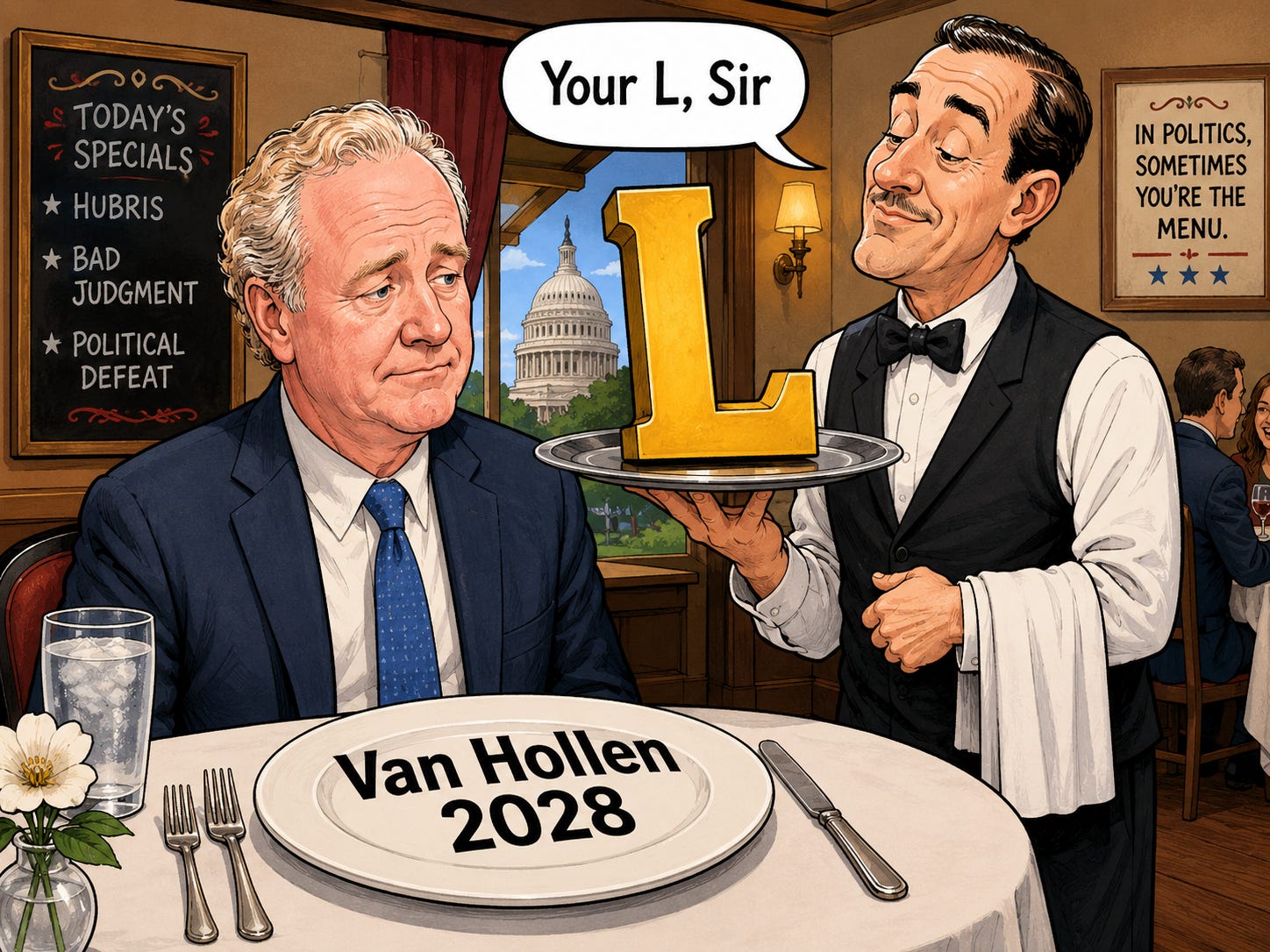
Many Are Called, But None are Chosen
Chris Van Hollen may be the latest Marylander to flirt with a run for President, but the track record of those candidates who have come before him says plenty.
Chris Van Hollen took a trip to New Hampshire last month, and he wants everyone to know it wasn’t quite what it looked like. “I went to New Hampshire because I was invited, but I would say kind of kicking the tires a little bit,” Van Hollen told the On NOTUS podcast, confirming he’s giving a 2028 presidential bid some real thought. He’s already carved out a lane as the Senate’s loudest Israel critic and the guy who flew to El Salvador for Kilmar Abrego Garcia, and now he’s doing the traditional first-in-the-nation dance.
Van Hollen can kick whatever tires he wants, but before Van Hollen gets too far down this road, someone should hand him the file on how this has gone for Marylanders before. Because it hasn’t gone well. Ever. No sitting or former president has been born in Maryland or lived here at the time he took office, and no major party has ever nominated a Marylander for the top of the ticket. The Old Line State builds governors, senators, and attorneys general who think they’re one primary away from the Oval Office. It has never once closed the deal.
Here’s the recent record Van Hollen is up against:
Martin O’Malley, 2016. The former Baltimore mayor and two-term governor launched his Democratic campaign in Federal Hill in May 2015, days after the Freddie Gray unrest put his old police record under a microscope he never wanted. He ran as the younger1, more competent2 alternative to Hillary Clinton. Bernie Sanders ran as the actual alternative to Hillary Clinton, and there was no room left for a third lane. O’Malley spent more time in Iowa than anyone else in the field and got 0.6 percent of the vote for his trouble, dropping out the same night the caucuses were still being counted. Those of us who were long-time O’Malley watchers got a very smug sense of satisfaction from watching O’Malley, who spent his entire term preparing to run for President, crash and burn.3
Ben Carson, 2016. Carson spent nearly three decades in Maryland as the celebrity pediatric neurosurgeon at Johns Hopkins, buying a 48-acre spread in West Friendship and becoming enough of a local fixture that the Baltimore Sun ran him as an honorary hometown hero. He’d already decamped to Florida by the time he announced in his actual hometown of Detroit in 2015, so the Maryland claim is more adopted-son than native-son.4 He led national GOP polls at one point in late 2015. Then came the debate stage, the biographical scrutiny, and the slow realization that a soft-spoken surgeon with no political experience was not built for a Trump-era primary. He ended up as Trump’s HUD secretary instead.
Larry Hogan, 2024 (sort of). Hogan never actually filed for president, but he spent the better part of 2023 as national co-chair of No Labels while pointedly not ruling out an independent bid against Trump and Biden. He stepped down from the group in a move widely read as 2024 positioning, then looked at the map, looked at his own polling (which showed him pulling more from Democrats than Republicans), and quietly walked into a Senate race instead. He lost that one too, to Angela Alsobrooks.
Notice the pattern. Every one of these was either a protest candidacy that never had oxygen (O’Malley), a celebrity vanity project that collapsed on contact with actual voters (Carson), or a bid that got talked about more than it ever got run (Hogan). None of them made it past the exploratory phase into anything resembling a viable delegate count.
Go back further, and the record gets even more instructive, because this is not a new habit.
Joseph I. France, 1920 and 1932. A Baltimore physician turned U.S. senator, France let it be known in 1920 that he’d accept a deadlocked convention’s draft. Problem was, nobody asked him to and nobody cared that he did. In 1932 he actually campaigned, running against Herbert Hoover in the Republican primaries as an anti-Prohibition protest candidate. He won more popular primary votes than Hoover did. It didn’t matter, because most delegates in 1932 still came from state conventions rather than primaries, and Hoover controlled those. France arrived at the Chicago convention with a following and left with almost no delegates, the original lesson in how winning the wrong kind of vote count in this country gets you nothing.
Albert Ritchie, 1924 and 1932. Maryland’s longest-serving governor, four terms and almost fifteen years in Annapolis, was a genuine national figure in his day: a conservative “wet” who fought Prohibition and picked fights with two Republican presidents over federal overreach. He was floated for the nomination in 1924, when the deadlocked convention settled on John W. Davis instead, then took an actual run at it in 1932. He arrived in Chicago to a hero’s welcome and 80,000 well-wishers at the train station, then watched Franklin Roosevelt bury him on the first ballot, 21 delegates to 664. FDR’s people reportedly dangled the vice presidency at him afterward. Ritchie said no, spent the next two years souring on the New Deal, and lost a fifth term as governor in 1934. Depending on how you count, he is either the closest a Marylander has come to the presidency or the clearest evidence of how far “closest” still is.5
Daniel Brewster, 1964. Brewster’s presidential run wasn’t really about Brewster. President Lyndon Johnson needed someone to stand in against Alabama Governor George Wallace in Maryland’s Democratic primary, since Wallace was using state-by-state protest votes to prove segregation had a national constituency, and a Maryland loss would have been read as exactly that. Brewster took the assignment, got booed, spat on, and buried in racist mail for his trouble, and still beat Wallace, though Wallace’s 43 percent showing rattled the party establishment badly. Maryland’s delegates dutifully cast their first ballot for Brewster, the ceremonial nod to the favorite son, then switched to Johnson like they were always going to. Brewster never had a path to the nomination and never wanted one; he was there to take a punch for somebody else’s campaign, which he did.
Sargent Shriver, 1976. Shriver, born in Westminster, was already the answer to a Maryland trivia question by 1976: founding director of the Peace Corps, architect of the War on Poverty, and George McGovern’s running mate after Thomas Eagleton was pushed off the 1972 ticket. He took an actual shot at the top of the ticket in 1976, running as a Kennedy-adjacent liberal in a field that also included Jimmy Carter. Shriver never found traction and dropped out after the first round of primaries, the shortest-lived campaign on this list next to Ritchie’s convention floor. He spent the following three decades building the Special Olympics into a global institution instead, which turned out to be the more durable legacy.
Alan Keyes, 1996, 2000, and 2008. Keyes is the trickiest entry here, because he was a New Yorker by birth and Illinois transplant by the end, and his Maryland chapter was really two Senate losses rather than a residency. The Maryland GOP drafted him to run against Paul Sarbanes in 1988 and again against Barbara Mikulski in 1992, and he lost both races by wide margins while attracting national attention for his oratory. That platform carried him into three Republican presidential primaries. His best showing was a 20 percent finish in the 2000 Utah primary, otherwise a steady stream of debate-stage moments and single-digit results. He never won a primary, a caucus, or a Maryland general election, which makes him either the most persistent Marylander on this list or the least electable, depending on how generous you’re feeling.
John Delaney, 2020. If persistence were the metric, Delaney wins going away. The former Montgomery County congressman announced in July 2017, the earliest campaign launch by a serious candidate in modern memory, and gave up his own House seat to do it. He self-funded to the tune of over $24 million, visited all 99 Iowa counties, and built out full-time operations in Iowa and New Hampshire while most of the field was still deciding whether to run at all. None of it worked. He never cracked 2 percent in a national poll and dropped out three days before the Iowa caucuses, citing a risk of siphoning votes from other moderates who still had a pulse. Two and a half years of campaigning bought him a debate-stage moment in Detroit and not much else.
Bobby Gawthrop, 2000. And then there’s Gawthrop, who belongs to a different category entirely: the fringe candidacy nobody outside a handful of ballot-access websites ever noticed. An Army veteran, teacher, and Baptist lay minister, Gawthrop ran as a self-described “Generation X” Republican with a campaign built around generational turnover, a message made slightly awkward by the fact that he hadn’t turned 35, the constitutional minimum age for the presidency, until 1999. He never came close to a debate stage, a primary win, or a headline. He is, in his own way, the purest distillation of the Maryland presidential tradition: total sincerity, zero chance.
Maryland’s third parties have their own bench, and it’s just as futile.
Michael Peroutka, 2004. Yeah, that one. The Anne Arundel County lawyer ran as the Constitution Party’s nominee on a platform of restoring biblical law to the federal government, and he actually did better than most names on this list by third-party standards: 143,630 votes nationally, about 0.12 percent, good for fifth place and the party’s best showing in its history at the time. Peroutka spent years as a board member of the League of the South, a group the Southern Poverty Law Center classifies as a neo-Confederate hate group, and once led a crowd in singing “Dixie” as what he called the region’s real national anthem. He resigned from the League a decade later, converted to being a Reublican, and won a term on the Anne Arundel County Council before eventually losing a 2022 primary bid for Maryland attorney general. The presidential run stayed the high-water mark.
Ian Schlakman, 2020. A former Baltimore Green Party co-chair who’d already run losing campaigns for U.S. House, Baltimore City Council, and Maryland governor, Schlakman was the first candidate to formally file with the FEC for the 2020 Green nomination. He built his pitch around solidarity organizing in Baltimore public housing and showing up at protests other candidates skipped. It wasn’t enough to keep the party’s internal process from working against him: he suspended his campaign in October 2019 in a dispute with national Green Party leadership over what he saw as favoritism toward Howie Hawkins, then left the party altogether. Hawkins won the nomination the following July.
Arvin Vohra, 2020. Maryland’s most prolific perennial candidate, Vohra ran and lost as a Libertarian for the U.S. House twice, the Maryland House of Delegates once, and the U.S. Senate once, all before serving as the Libertarian National Committee’s vice chair and then launching a 2020 presidential bid after his own party declined to re-elect him to that post. He built a national profile mostly through controversy, including remarks about age-of-consent laws and the military that even fellow Libertarians called needlessly abrasive. At the 2020 convention he limped through the nominating rounds in the single digits before being eliminated and endorsing rival candidate Adam Kokesh. Jo Jorgensen won instead.
Van Hollen’s argument for himself, that operating inside “the confines of the halls of Congress is not a successful recipe for actually getting change,” is at least a real theory of the race. It’s also the same theory every senator running for president has told themselves since the Senate existed. What Van Hollen actually offers is a niche: he wants Israel policy to be a 2028 litmus test in a way most of the field, from Newsom to Beshear to Harris, has been careful to avoid. That’s a lane. It is not obviously a winning one in a Democratic primary that will still include plenty of voters who don’t want a candidate defined by foreign policy purity tests.
If Van Hollen gets in, he’ll be running against the same structural problem every Marylander before him has run into: this state produces credible, competent, thoroughly Washington-adjacent politicians, and credible and competent has never once been enough to win a presidential primary. Thirteen of them have tried across more than a century, from a Baltimore doctor who out-polled a sitting president and got nothing for it, to a Baptist lay minister who couldn’t legally hold the office until the year he ran, to a trio of third-party true believers who couldn’t even win their own conventions. Every single one left with a concession speech and a consolation prize. Van Hollen should decide whether he wants a third term in the Senate or a spot on that list, because right now “kicking the tires” is exactly what O’Malley, Carson, and Hogan all called it too, right before it didn’t work out.
This was accurate
This was not
ATTN: Wes Moore
Maryland will still take credit for Carson. We take credit for a lot of things.
Spiro Agnew technically got closer to the presidency than any of these folks, considering he was a heartbeat away from it as Nixon's vice president. He just never ran for the job himself, and given how his second term ended, that's probably for the best for everyone's sake, including his.