Night and Day Difference on Weed
Two States, One Plant, and Why Maryland Smells Like a Grateful Dead Parking Lot
Last week I was traveling in Florida. Two things stuck out, both related to marijuana. Both where you can get it, and what it does to the smell of your surroundings.
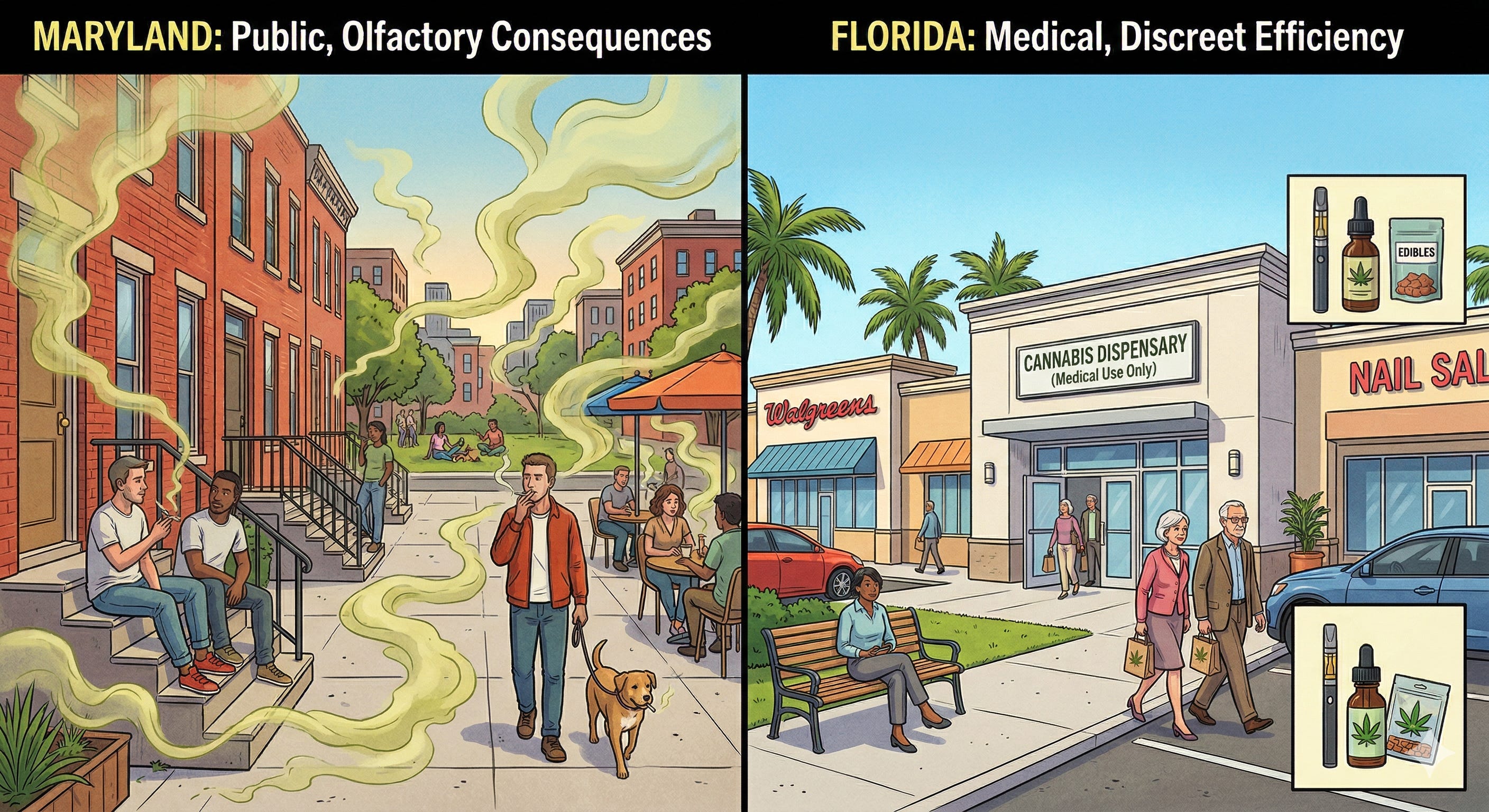
Florida has more cannabis dispensaries per capita than almost any state in the country. You can find one on nearly every commercial strip, tucked between a Walgreens and a nail salon, operating with the quiet efficiency of a medical office. And yet, walking around Miami or Tampa or Jacksonville, you almost never smell marijuana. Not in parks. Not on sidewalks. Not wafting through outdoor dining areas.
Then there’s Maryland.
Maryland legalized recreational cannabis in July 2023, and the olfactory consequences have been immediate and inescapable. Walk through Fells Point on a weekend evening, sit in a park in Silver Spring, or simply drive with your windows down in most of the state’s urban or even suburban corridors, and you will encounter the smell. In the air. On people’s clothes. Constantly there. It is, at this point, essentially ambient.
The legal explanation is straightforward.
Florida’s cannabis market is still medical-only. You need a card, a doctor’s recommendation, and a legitimate condition to purchase. That regulatory framework shapes consumer behavior even when enforcement is loose: medical patients tend to treat their cannabis like any other prescription, taking it home and using it privately. The dispensary is a pharmacy, not a social hub.
Maryland flipped the cultural script the moment recreational use became legal. Suddenly, the product was normalized and it moved out of private spaces and into public ones. Smoking a joint on a stoop or in a park stopped being a legal risk and started being a lifestyle choice. Sadly, a lot of Marylanders made that choice immediately and enthusiastically.
There’s a deeper cultural layer here. Baltimore in particular has a decades-long tradition of open cannabis use that predates legalization by a generation. The city effectively decriminalized public smoking through sheer social convention long before the state got around to making it official. Legalization didn’t create new behavior; it just removed the last ambient pressure to be discreet. The result is a city where the smell is now essentially inescapable.
I’ve written about this here before, more than once.
Florida’s fragmented regional culture cuts the other way. The state is a patchwork of retiree communities, Cuban-American Miami, the rural and socially conservative Panhandle, and a tourist infrastructure that implicitly keeps public spaces family-coded. None of those subcultures has a tradition of outdoor cannabis use. The product preference also matters: Florida’s medical market has pushed heavily toward vapes, edibles, and tinctures rather than flower, partly because an older and more medically-oriented clientele prefers non-combustion delivery methods. Less flower means less smell, full stop.
The smell problem in Maryland is the predictable consequence of legalizing recreational use in a state where public cannabis culture was already well-established informally, while providing essentially no enforcement infrastructure for public consumption rules. The law says you can’t smoke in public. Nobody enforces it. So people smoke in public.
Maryland's public consumption fine is $250. It is, to put it charitably, not a deterrent.
Florida will almost certainly pass a recreational legalization measure eventually. When it does, watch whether the smell follows. My guess is it won’t, at least not to Maryland’s degree. The cultural substrate isn’t there, the product mix tilts away from flower, and frankly, Floridians are too busy dealing with the heat to stand around smoking outside.
Maryland has made its choice, and we’re worse off for it.