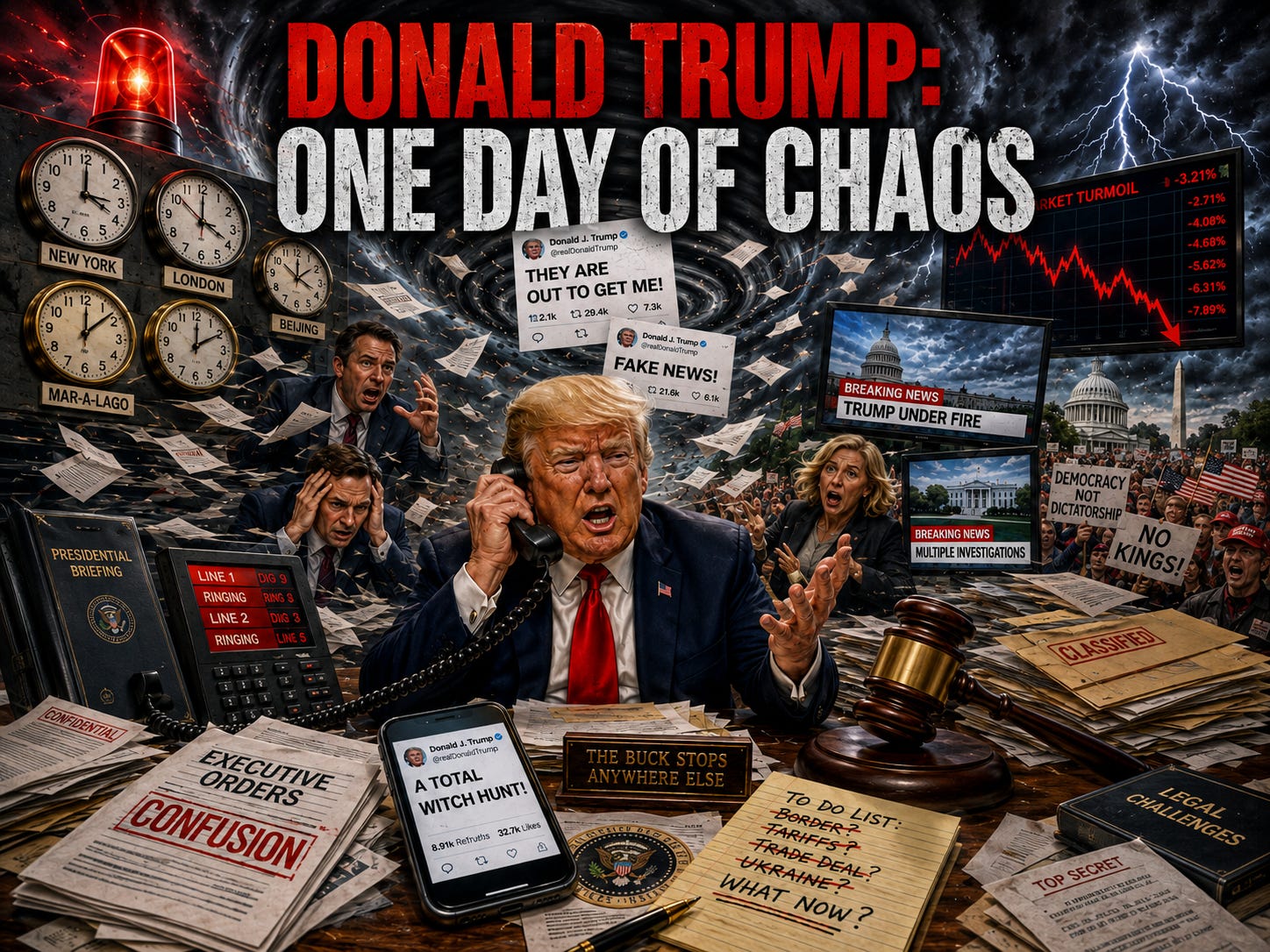
It’s September 2nd. Take a moment and consider that fact alone: not a special anniversary, not the day after a big speech, just a regular Wednesday in the second year of Donald Trump’s second term. And in the span of about twelve hours, the following things happened, all reported independently by outlets across the ideological spectrum. I’m not cherry-picking a bad week. This is one day.
Start with the polling, because it sets the table for everything else. A new Gallup survey found that nearly nine in ten Americans now believe government corruption is widespread, the highest that number has been in twenty years of asking the question. The jump has been driven overwhelmingly by Democrats, but more than eight in ten Republicans agree too, which tells you this isn’t just partisan noise. When the public believes the government is dirty at a rate that outpaces every other advanced democracy, that’s not a talking point. That’s a legitimacy problem.
Then there’s the money. Reuters reported that the national debt has surged past $40 trillion in the first nineteen months of Trump’s second term, despite a campaign built on promises of fiscal restraint, a leaner federal government, and an end to “forever wars.” Instead, federal spending has grown. The Iran war, six months old and still an expensive stalemate, keeps adding to the tab. DOGE, which Elon Musk once promised would slash $2 trillion, ended up reporting $110 billion in savings, and even that figure relied on claims the Government Accountability Office called overstated or unverifiable.1 Borrowing costs are climbing right along with the debt, which means this isn’t an abstract number on a Treasury spreadsheet. It shows up in mortgage rates. Trump, having flip-flopped on the importance of affordability, seems disinclined to address any of this.
While the debt clock ticks, the president is renaming things. Trump signed an executive order changing Lake Ontario to “Lake America” as leverage in his trade war with Canada, and a new Reuters-Ipsos poll found Americans oppose the move 63% to 14%, a more lopsided margin than the Gulf of America rebrand drew last year. The new tariffs on Canadian goods fare almost as badly, opposed nearly 3-to-1, with just 9% of the country strongly supporting them. Even a plurality of Republicans aren’t fired up about it. Undeterred, and apparently unable to help himself, Trump floated renaming the Strait of Hormuz the “Trump Strait” on Truth Social, because the U.S. now supposedly controls it after the war with Iran, a claim that arrived alongside a fresh round of CENTCOM strikes on Iranian targets rather than the ceasefire he keeps implying is around the corner. Iran, for its part, has made clear it isn’t going anywhere. The strait can’t be seized by tweet. None of the geographic vanity projects are free, either. The U.S. Mint announced that $1 coins bearing Trump’s likeness have officially entered circulation and are now for sale. Only 9% of Americans, per a recent Pew poll, think it’s appropriate to name things after a sitting president. The Mint didn’t seem to care what the public thought either.
If the renaming spree is the campy half of the day, the machinery being built around the midterms is the part that should actually keep you up. The New York Times reported that DHS has quietly assigned hundreds of federal agents to a weekslong hunt for noncitizens on the voter rolls, an effort the administration is internally calling the “Unlawful Voter Initiative,” despite decades of evidence that this kind of fraud is vanishingly rare. Agents are pulling names from federal databases and running them against state voter files, some through portals that were built for individual voters to check their own registration, not for federal agents to mine at scale. At the same time, the Times separately reported that the Postal Service has rushed a new mail-ballot screening system into place to comply with Trump’s executive order restricting voting by mail, one built so fast and so haphazardly, according to a whistleblower complaint sent to Senator Richard Blumenthal, that a single bad barcode could get an entire batch of ballots rejected. And ICE, an agency whose stated job is immigration enforcement, is now soliciting a contractor to build it a national voter database worth up to $5 million, compiling voter registration and voting history files from as many states as it can get its hands on. Three different federal agencies, three different pieces of infrastructure, all pointed at the same unproven premise, all landing in the two months before an election Republicans are worried about losing.
Which brings us to the man himself, who does seem to grasp that his party’s margins are thin. Trump told reporters he intends to spend the final month before the election barnstorming roughly 35 competitive races, starting with a trip to Alaska to campaign for Senator Dan Sullivan. It’s a notable turnaround given that his super PAC’s first midterm ads, per new CNN reporting, are barely about the Republicans on the ballot at all. Instead, the ads are built almost entirely around Trump, with one spot featuring Dana White praising him like it’s a UFC introduction. Whether that instinct helps or hurts the candidates actually running this fall is an open question. Trump’s approval rating is sitting at 33%, the lowest of his political career.
Meanwhile, the actual security apparatus of the federal government keeps getting bent toward the president’s enemies list, real and perceived. The Atlantic reported that the FBI directed federal air marshals to covertly surveil former Congressman Eric Swalwell on an international flight, watching him use his devices in hopes of visually catching his passcodes, a tactic normally reserved for suspected terrorists and hijackers, not a former member of Congress who happened to sit on Trump’s second impeachment trial.2 Swalwell is separately under investigation over serious personal misconduct allegations, and that investigation may well be legitimate. But repurposing an anti-terrorism surveillance tool against a political opponent, without the directive even specifying what it was for, is the kind of institutional creep that should worry people regardless of what they think of Swalwell. The instinct to control information runs the other direction too. The Washington Post reported that the Pentagon pulled decades of classified documents off the internal network used by defense officials and troops, after the Post published senior generals’ private warnings to Hegseth that the Iran war was becoming unsustainable. A Pentagon spokesman wouldn’t discuss it but didn’t deny it happened either.
At the Pentagon more broadly, the churn keeps churning. Army Secretary Dan Driscoll resigned after reportedly raising concerns directly with Trump about the state of the Army under Secretary of Defense Pete Hegseth, becoming at least the twenty-fifth senior Pentagon official to depart since Hegseth took over. House Armed Services Chairman Mike Rogers, a Republican, said flatly that he’s “tired of all the churn.” The Army now has just five active-duty four-star generals, the fewest in decades, while lawmakers are being asked to rubber-stamp a $1.5 trillion defense budget. This is happening in the middle of an active war. Somehow the wartime defense secretary keeps having more time to purge his own officer corps, and now scrub the record of who warned him what, than the war seems to require.
And down on the southern border, the administration is making clear that local input was never really on the table either. Axios reported that Customs and Border Protection Commissioner Rodney Scott told Texas border county officials, in a closed-door meeting, that wall construction plans are “not negotiable,” including through Big Bend National Park, despite local objections about cost, environmental damage, and the fact that the terrain sees relatively few crossings to begin with. Private landowners and business owners weren’t even invited to make their case. One county judge put it more bluntly than I would: it’s like pissing in the wind.
And because no day is complete without a reminder of what actually occupies the president’s headspace, Trump told reporters he’s “happy” that Prince Harry and Meghan Markle are moving back to Britain, adding he “wouldn’t have taken them back” if he ran the royal family. This is the same afternoon as the debt figures, the voter surveillance rollout, and the Pentagon document purge. Priorities.
On top of it, we learned today that one reason Army Secretary Driscoll resigned is that during a meeting with the President, Trump was less concerned in addressing Driscoll’s concerns about the war in Iran and instead talked about nothing but his ballroom.
Read back through all of that. A collapsing trust in institutions. A debt spiraling past the psychologically significant $40 trillion mark. A trade war and a vanity renaming campaign that the public overwhelmingly rejects, followed almost immediately by another one, and then a third. Three separate federal agencies quietly building the plumbing to police, screen, or database voters ahead of an election the president’s party is worried about losing. A former member of Congress surveilled with terrorism tools. A defense department scrubbing its own classified record after generals’ warnings leaked. A wartime defense secretary hemorrhaging senior leadership. Local elected officials told their input doesn’t matter. And a president with enough bandwidth left over to weigh in on the Sussexes’ moving plans.
This is not a week’s worth of news, or a month’s. It’s one day. And it’s worth pointing out that this level of chaos has become normal enough that most of these stories won’t be the top headline by Thursday morning, because something else will have happened by then. That’s the real scandal here, not any single decision but the sheer volume of them, and the fact that the country’s capacity for outrage simply can’t keep pace. The people who should be doing something about it, starting with the Republicans in Congress who control both chambers, mostly aren’t.
The White House did not respond to a request for comment on the GAO's findings, which is its own kind of answer.
Deputy Chief of Staff Stephen Miller has called Swalwell a "scumbag" on national television, so it's fair to say this wasn't a neutral request from a neutral agency.