


State Senator Joanne Benson accidentally said the quiet part out loud yesterday:
A senior Maryland Senate Democrat who supported the Blueprint for Maryland’s Future now says the education plan is not delivering the academic progress lawmakers expected and should be reexamined.
State Sen. Joanne Benson, of Prince George’s County, strongly supported the Blueprint when lawmakers approved it.
“At that time, I thought it was an effective tool,” Benson told FOX45.
The General Assembly voted in 2021 to override then-Gov. Larry Hogan’s veto of the Blueprint, enacting the largest education funding increase in state history. More than five years later, Benson’s support is waning.
“They need to go back and take a look, because while we may be making little progress, [they’re] baby steps,” Benson said. “The kind of money that we’re throwing at this program is not serving the purpose for which I believe the Blueprint was written in the first place
Benson seems to think that this is a new outcome. But it was one that was easily predictable long before the Blueprint was passed.
I wrote this about the Kirwin Commission in 2017, and it was so spot on I’m going to quote it at length:
According to the Maryland Manual the commission’s charge is to:
… review and assess current education financing formulas and accountability measures, and how each local school system is spending its funds, including the increased State funds… and review the Study on Adequacy of Funding for Education in the State of Maryland, required by the Bridge to Excellence in Public Schools Act.
Not a lot in that charge about innovation.
And true to form the Kirwan Commission has been all about funding and less about innovation. Holding meetings for more than a year, there’s been barely any talk of innovation—other than potential new ways to spend more taxpayer dollars, as evidenced by the teachers union constantly flogging a consultant report showing Maryland needs to spend $3 billion more on education.
Of course it’s the same consultant that told the Thornton Commission nearly a decade ago that Maryland needed to spend more money.
And not co-incidentally said consultant consistently submits reports that states must spend more money on education.
Starting in 2001, every one of the studies Augenblick was paid to produce came to the same conclusion: Taxpayers must come up with hundreds of millions of additional dollars to properly educate public school students. The company recommended spending hikes that ranged from 3.6 percent (Nevada, 2006) to 61.4 percent (Montana, 2007).
In 2013, the company concluded that the District of Columbia needed to spend 22.1 percent more to adequately educate students. As of 2012, Washington, D.C. public schools spent nearly $30,000 per student, according to the U.S. Census Bureau.
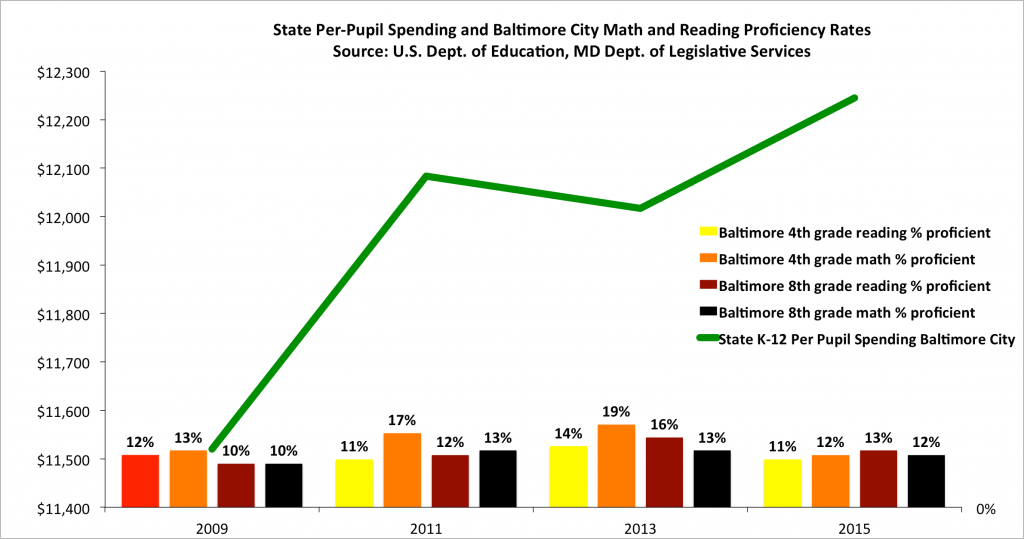
Since Thornton funding increased kicked in in 2003, state funding has increased from $3 billion per year to more than $6 billion per year. Factor in local and federal funding, Maryland’s public schools receive nearly $12 billion per year.
The ostensible purpose behind the Thornton formula increases was to reduce the achievement gap between poor minority students and their white peers.
What has been the return on that investment? Appalling proficiency rates among Maryland’s most vulnerable students. As Maryland increased per-pupil funding to Baltimore City’s schools proficiency 8th graders in math ranged from 10 percent, to 12 percent, and 10 percent to 13% for 4th graders in reading.
It should be noted that as this travesty was occurring during the eight years of the O’Malley administration, the teacher’s union and their Democratic allies patted themselves on the back for Maryland’s “number one” Education Week rankings, as the same reports showed Maryland at or near the bottom of the nation in the achievement gap.
The poor ROI on a 100 percent increase in education spending would lead one to ask about accountability. But, we’re talking about the unaccountable teacher’s union here. Hence the reason why they rammed through the unconscionable and misleadingly named Protect Our Schools Act, over Governor Hogan’s veto. The act does more to insulate the union from accountability for its failure’s and protect it from innovative competitors, who have shown the capability to succeed in areas it has failed.
Pair the Kirwan Commission’s singular focus on education funding over innovation with the Protect Our Schools Act, and you find the teacher’s union and their Democratic stooges want more money and less accountability… which is exactly what every monopoly wants.
So what Benson is seeing may be a surprise to her, but it is far from a surprise to people who were paying attention to the machinations of the Kirwin Commission. None of this is a surprise to the people who read the Blueprint for Maryland’s Future. None of this is a surprise to people who read Governor Larry Hogan’s letter vetoing the blueprint bill. And none of this is a surprise to people who have long studied the way the Maryland State Education Association works in dodging accountability for teachers, administrators, and the Democrats they help elect.
Boards of Education (and probably legislative Democrats) will try to blame a lack of full funding for why things aren’t changing and outcomes aren’t improving. But students were always the biggest losers when it came to the Blueprint, and we all damn well knew it to be the case long before the Blueprint passed.
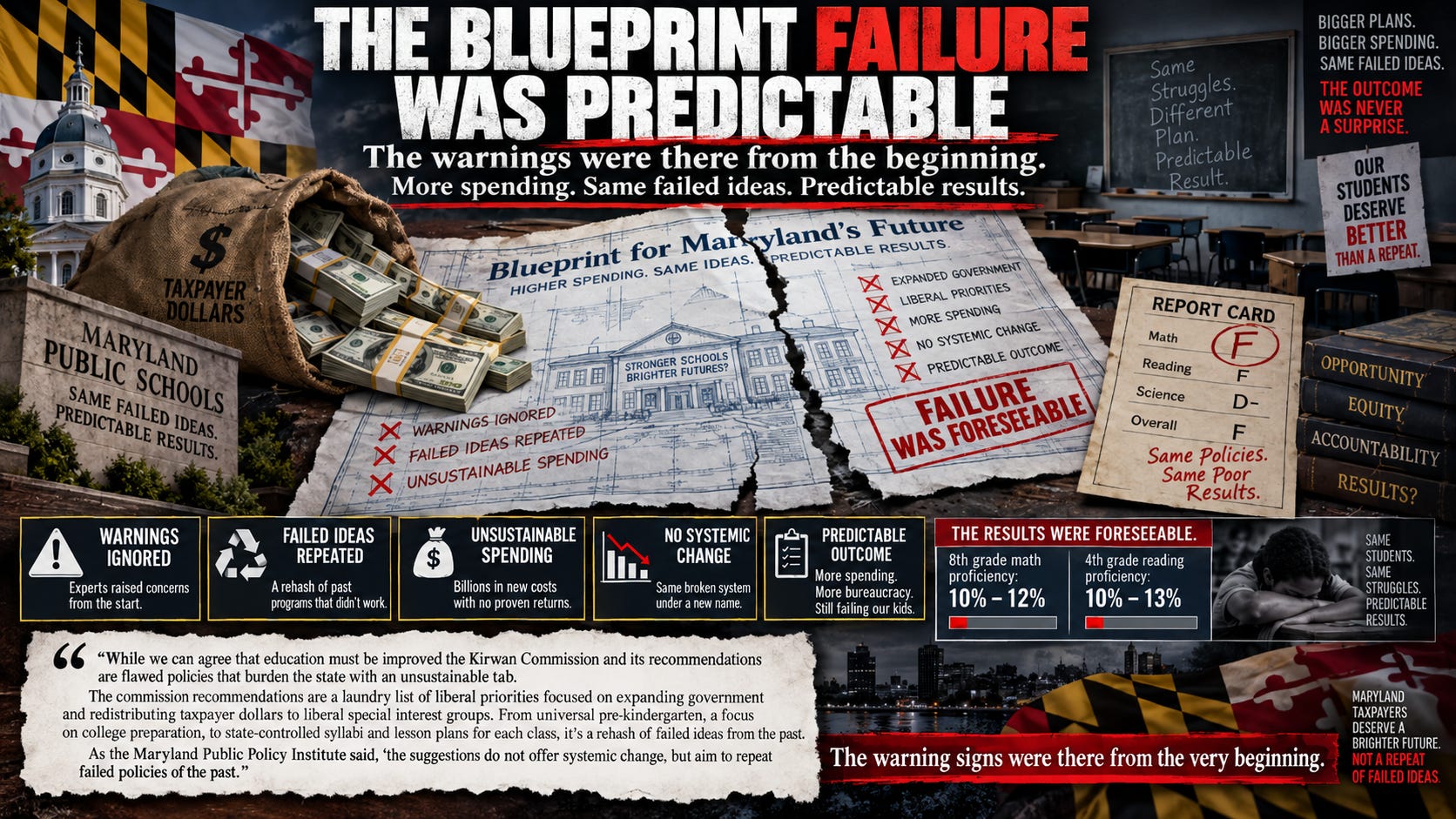
While we can agree that education must be improved the Kirwan Commission and its recommendations are flawed policies that burden the state with an unsustainable tab.
The commission recommendations are a laundry list of liberal priorities focused on expanding government and redistributing taxpayer dollars to liberal special interest groups. From universal pre-kindergarten, a focus on college preparation, to state-controlled syllabi and lesson plans for each class, it’s a rehash of failed ideas from the past.
As the Maryland Public Policy Institute said, “the suggestions do not offer systemic change, but aim to repeat failed policies of the past.”
While I’m glad at least one Democrat recognizes that the Blueprint failed, I shudder to think what far-left legislative Democrats will try to replace it with. While the Blueprint was a predictable disaster, what the current crop of radical Senators and Delegates propose will likely be an extinction-level event for Maryland’s economy and Maryland’s middle class. They will propose more money and less accountability than ever before.
The Thornton Commission plan was bad. The Kirwan Commission Blueprint was just as bad. What’s next will be far, far worse.
Maybe this time, somebody will actually heed the numerous warnings that were given and avoid another calamitous and expensive mistake.