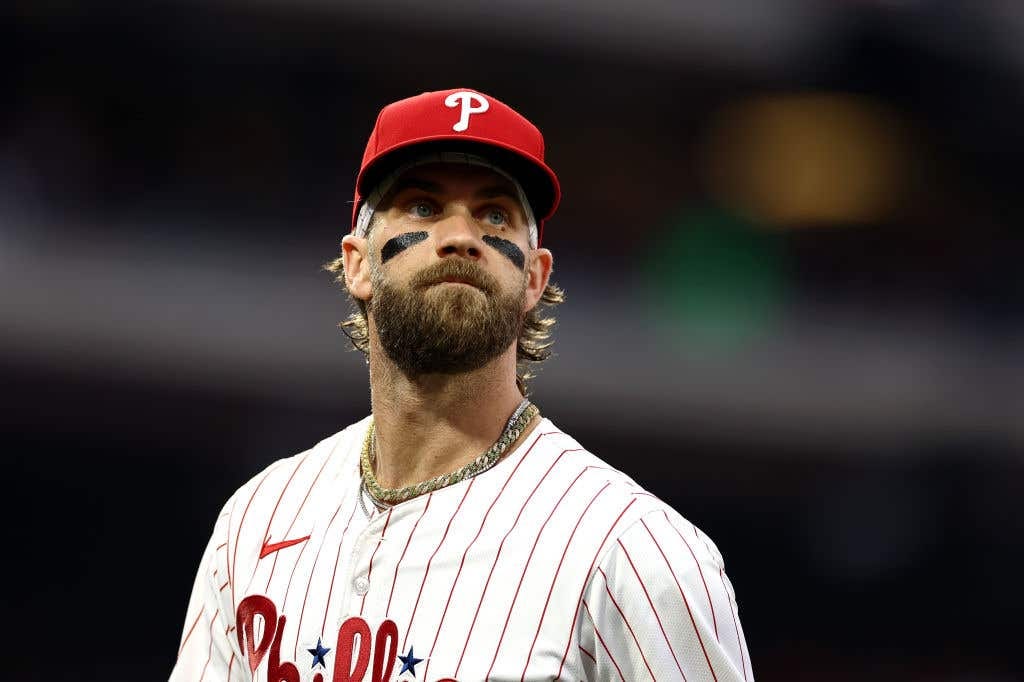
The Chosen One, 16 Years Later
Did Bryce Harper ever live up to the hype. And is it even fair to compare him to it?
Rob Manfred handed Bryce Harper a gift. Snubbed by the fans and the players in the vote for the All-Star Game his own franchise is hosting for the first time in 30 years, Harper got in anyway, tapped as the Commissioner’s “Legend Pick.” It’s his ninth All-Star nod, and it comes almost exactly a year after Harper told Manfred to get the hell out of the Phillies clubhouse during a salary cap shouting match. Baseball has a short memory when a guy is hitting .274 with 20 homers at the break.1
But the “legend” framing is worth sitting with for a second, because it invites the question nobody wants to ask out loud in Philadelphia or Washington: has Bryce Harper actually lived up to the hype, or have we just collectively agreed to grade him on a curve for so long that “very good, occasionally great” now reads as “legend”?
Go back to where this started. Harper was on the cover of Sports Illustrated at 16 years old as “Baseball’s Chosen One,” a comparison to LeBron James that no other amateur athlete in this sport has ever received before or since. He left high school early, got his GED, and torched junior college pitching well enough to win the Golden Spikes Award as the best amateur player in the country. The Nationals took him first overall in 2010 not because he was the safest pick, but because he was supposed to be a generational one. This wasn’t Stephen Strasburg hype (a very good pitcher who got hurt). This was “we may be looking at the best player of his generation” hype, delivered before the kid could legally rent a car.
So what actually happened?
Rookie of the Year in 2012 at 19, becoming the youngest position player ever to make an All-Star team that same season.
A unanimous NL MVP in 2015, still the youngest unanimous MVP in history, on a season (.330/.460/.649, 42 doubles, 118 walks) that genuinely was as good as advertised.
A record $330 million free agent deal with the Phillies in 2019, the largest in the sport’s history at signing.
A second NL MVP in 2021.
A trip to the World Series in 2022, though not a ring.
Tommy John surgery in late 2022, a shift to first base to save his arm, and a decline in the throwing tools that were once part of the five-tool sales pitch.
Nine All-Star selections and counting, three hundred career home runs reached faster than all but a handful of players in history.
That is, by any reasonable definition, a Hall of Fame career. It is not, however, the career that was promised in 2010. The promise was Ruthian, a player who would routinely finish first in MVP voting rather than sixth or twelfth, a five-tool talent whose arm and legs would age as gracefully as his bat. What Harper delivered instead is a career with two enormous peaks (2015 and 2021) surrounded by long stretches of merely very good, punctuated by injuries and a defensive profile that degraded so fast the Phillies moved him off the field entirely.2 He has never finished top three in MVP voting outside his two winning seasons. He has never won a World Series, and the 2022 Phillies lost that series to a Houston team he outproduced individually. He has been genuinely elite in roughly four of his fourteen full seasons. The rest has ranged from good to very good, which is a fine career for almost anyone not measured against a Sports Illustrated cover from age 16.
None of this makes Harper a bust, and it would be dishonest to pretend otherwise. Two MVPs before turning 29 is rarefied territory. But “underperformed relative to expectations” and “had a bad career” are two entirely different claims, and Harper is a clean example of the first without being anywhere close to the second. The expectations set for him in 2010 were built for a player who doesn’t really exist: a five-tool talent who ages like a corner outfielder well into his late thirties while also hitting like peak Miguel Cabrera every year. Nobody does that. Harper’s actual career, MVP twice, All-Star nine times, a franchise-record contract, a World Series appearance, no championship, is what an outstanding but mortal ballplayer’s career looks like when the hype machine decided in advance that mortal wasn’t an option.
Manfred calling him a “legend” this week isn’t really about the stat line. It’s about managing the gap between the Chosen One narrative from 2009 and the very good, sometimes great player Harper turned into. The league needed a headline for a hometown All-Star Game, and “very good first baseman having a nice bounce-back year” doesn’t sell tickets. “Legend” does. Harper deserved his spot on that roster this year. He didn’t deserve, and never really deserved, the burden of being compared to Ruth before he’d played a single professional game. The hype set him up to disappoint almost anyone who was paying attention in 2009, and the fact that he’s still a good story fifteen years later says more about his durability than it does about baseball’s willingness to admit when it oversold a teenager.3
For context, this is the same union rep who once needed security to separate him from the Commissioner. Baseball forgives fast when the on-base percentage is north of .360.
Ryan Howard, Chuck Klein, and Lefty O'Doul are the only other Phillies to slash .300/.400/.600 in a season since 1900. Harper did it in 2021. That's the ceiling. The floor has been a first baseman who can't throw anymore.
Let’s be clear; most of us would give up a body part to have the career Harper has had. But then again, most of us weren’t on the cover of SI, either.