The Trillionaire's Choice
Man's law should never require somebody to share their wealth. God's Law, however, tells us something else.
Elon Musk officially became a trillionaire last week. The number is so large it barely registers as real. A trillion dollars. If you spent a million dollars a day, every day, it would take you roughly 2,700 years to run out. The Roman Empire rose and fell in less time.
Being a trillionaire is not a sin. That needs to be said plainly, because a lot of the discourse around extreme wealth collapses into a kind of reflexive moral panic that doesn’t actually engage with the hard questions. Musk built things. Tesla transformed the automotive industry. SpaceX broke open a government monopoly on space access and made reusable rocketry a reality. These are genuine achievements, and the wealth that followed from them, while staggering, is not illegitimate on its face.
The sin, if there is one, is what Musk has done with the opportunity his wealth represents.
In 2021, David Beasley, then director of the United Nations World Food Programme, made a specific and modest ask. He said $6 billion, roughly 2 percent of Musk’s net worth at the time, could help save 42 million people from starvation. It would not solve hunger permanently. It would not fix the global food system. But it would save 42 million people from dying that year. Musk’s response was, in its way, clever. He went on Twitter and said he would sell Tesla stock immediately if the WFP could show, on an open-source thread, exactly how $6 billion would solve the problem.
The WFP did exactly that. They outlined a $6.6 billion plan: $3.5 billion for food and delivery, $2 billion for cash and voucher programs, the remainder for operations. They were careful to note this wouldn’t “end” world hunger. It would provide emergency meals and vouchers to 42 million people for a year. They published the plan. They answered the question.
Musk never wrote the check.
He criticized the WFP for a lack of structural transparency. He moved on. The people who would have been fed remained unfed.
Nobody is obligated to give away their money. Libertarians will make this point, and they are correct. There is no law requiring Elon Musk to donate to anything, and moral arguments rooted in compulsion tend to backfire anyway. But “not legally required” and “not morally accountable” are not the same thing. Character is revealed in the choices you make when nothing stops you from doing the right thing except not wanting to.
Musk set the terms. The WFP met them. He walked away.
That is worth sitting with for a moment. Musk asked for transparency, Musk got transparency, and Musk kept his checkbook closed. The goalposts didn’t move; they vanished. And 42 million people remained in acute food crisis because a man who could write that check from his couch without meaningfully affecting his net worth decided the accountability he demanded was somehow still insufficient.
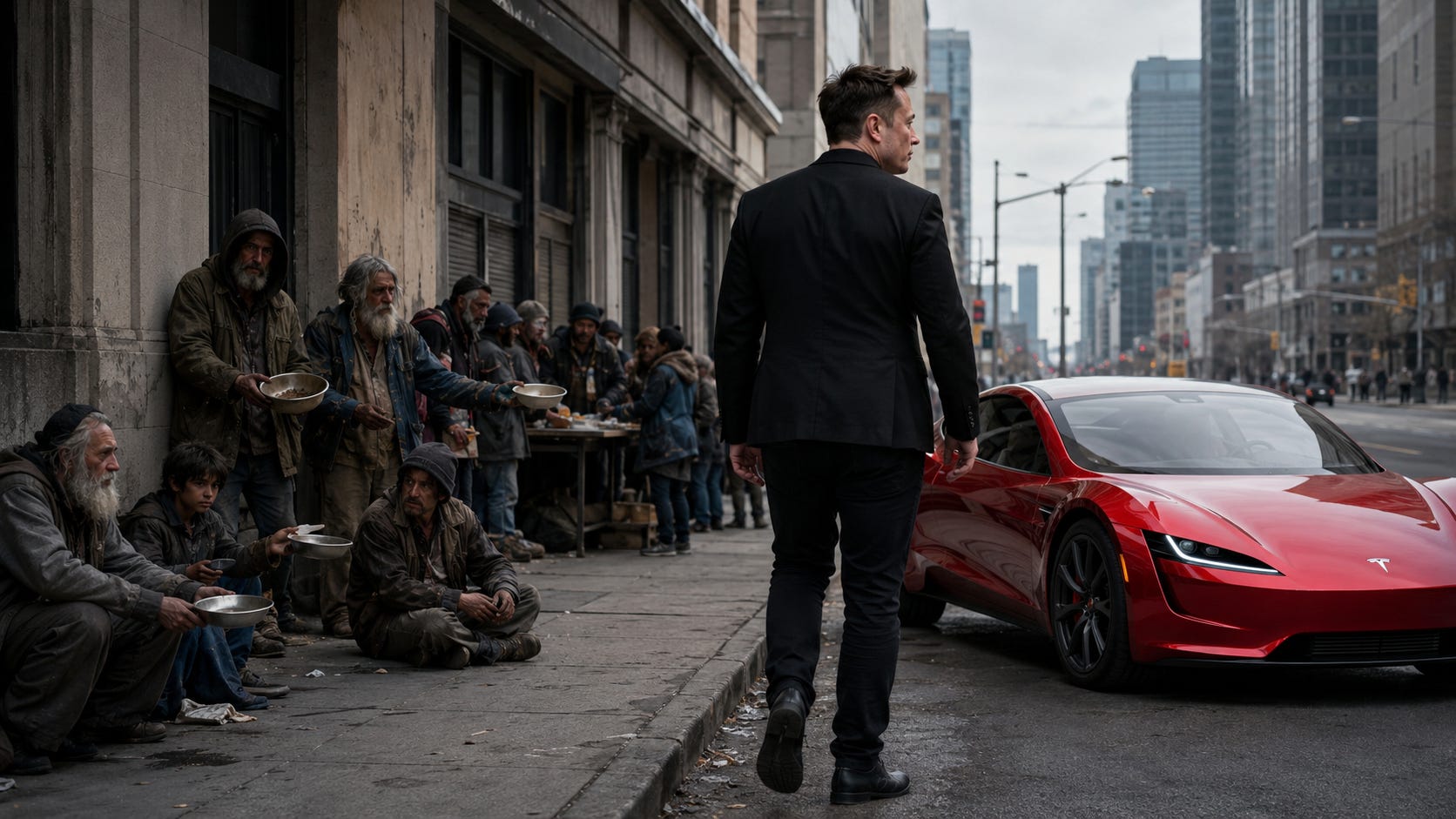
There is a version of Musk that history would celebrate unconditionally: the industrialist who dragged humanity into a cleaner energy future and also, when the moment came, fed tens of millions of starving people because he could and it cost him almost nothing in any meaningful sense. That version of Musk does not exist. The version that does is a man who is extraordinarily talented at building things and extraordinarily resistant to the idea that his wealth carries any moral obligation beyond his own priorities.
Talent is not character. Wealth is not virtue. Accumulating a trillion dollars and then declining to spend $6 billion of it to prevent mass starvation, after publicly promising to do so if conditions were met, is not a neutral act. It is a choice, and it tells you something.
Not every billionaire is a moral failure. Some give substantially and without fanfare. The question Musk keeps failing is simpler than a philosophical treatise on redistributive ethics: he made a specific promise tied to a specific condition, the condition was met, and he walked away. That’s not a systemic critique of capitalism. That’s just watching someone reveal who they are.
Being the richest person in human history is not a sin. Having the resources to prevent mass starvation for 42 million people and choosing not to, after setting the terms yourself, is a character flaw. The distinction matters because one is about accumulation and the other is about what you do when accumulation gives you genuine power to act.1
Man’s law should never require somebody to share their wealth. God’s Law, however, tells us something else clearly and distinctly.
Then he will say to those on his left, ‘Depart from me, you accursed, into the eternal fire prepared for the devil and his angels.
For I was hungry and you gave me no food, I was thirsty and you gave me no drink, stranger and you gave me no welcome, naked and you gave me no clothing, ill and in prison, and you did not care for me.’
Then they will answer and say, ‘Lord, when did we see you hungry or thirsty or a stranger or naked or ill or in prison, and not minister to your needs?’
He will answer them, ‘Amen, I say to you, what you did not do for one of these least ones, you did not do for me.’
Musk has that power. He just isn’t using it.2
Today’s Gospel Reading, ironically, was Jesus Commissioning the Twelve. “Cure the sick, raise the dead, cleanse lepers, drive out demons. Without cost you have received; without cost you are to give.” While Musk may have built Tesla, he did it with talent on loan from God (to borrow a phrase from Rush Limbaugh) free of charge.
The WFP's detailed budget response, which Musk himself solicited, has been largely forgotten in coverage of this episode. It probably shouldn't be. They did what he asked.