


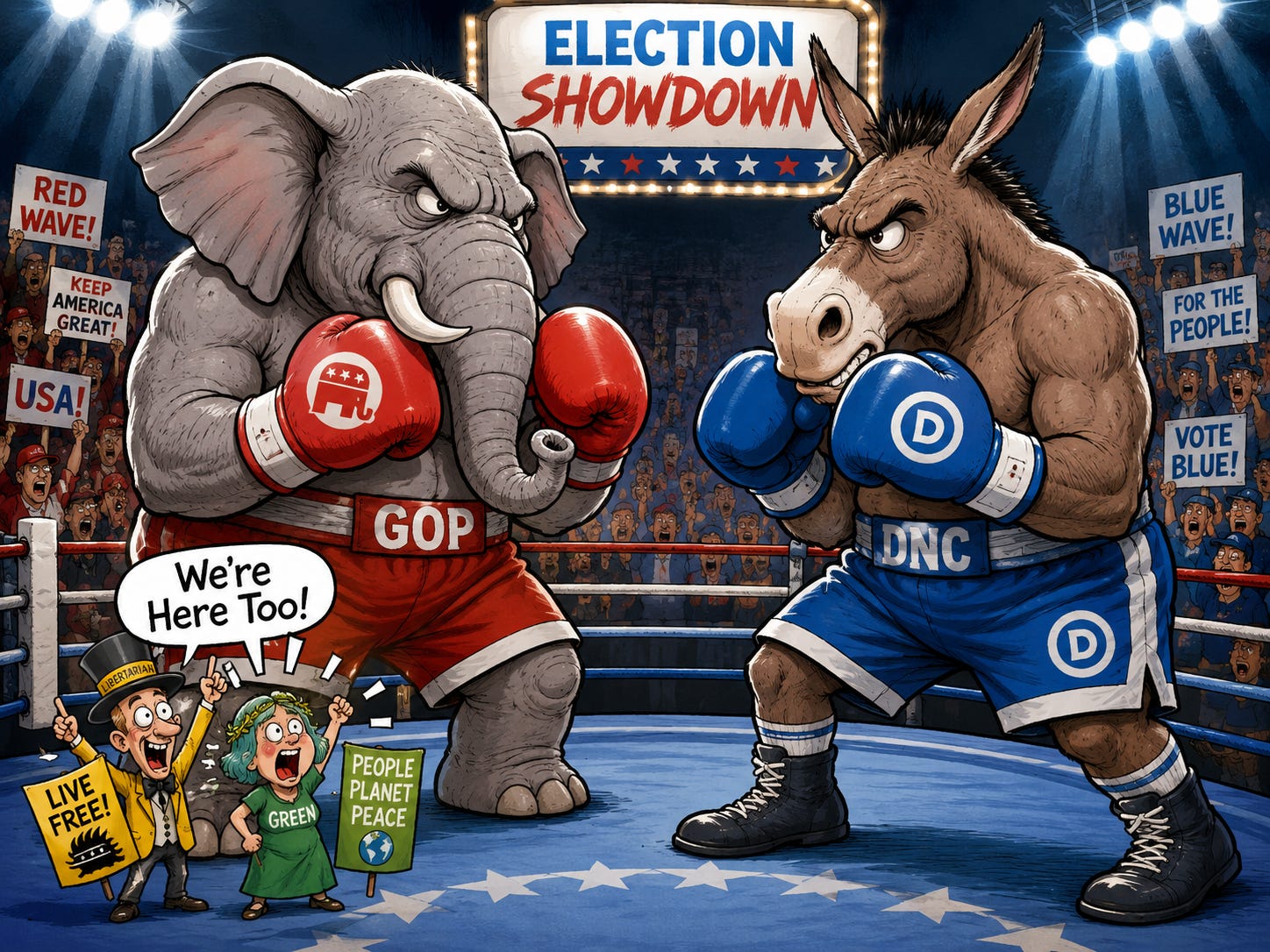
When we first ran our General Election Predictive Metric, the Universal General Election Probability Model, after the California, Maryland, and Texas primaries, we forgot one important outlier for two of those states: third-party and independent candidates.
Our model has been updated to reflect that. The original two-candidate version of the model converts a margin into a win probability with a logistic curve. That works fine when there are only two names on the ballot. It falls apart the moment you add a Green Party nominee or a Libertarian, because there’s no clean way to express “Candidate A minus Candidate B” when there are four candidates instead of two. The fix: every candidate gets a value score built from the same inputs (structural lean, pWAR delta against replacement level, environment, incumbency, funding, scandal, turnout), and the values get converted to probabilities through a softmax function instead of a single logistic curve. Same architecture, same weights, now built for a real ballot instead of a hypothetical binary.