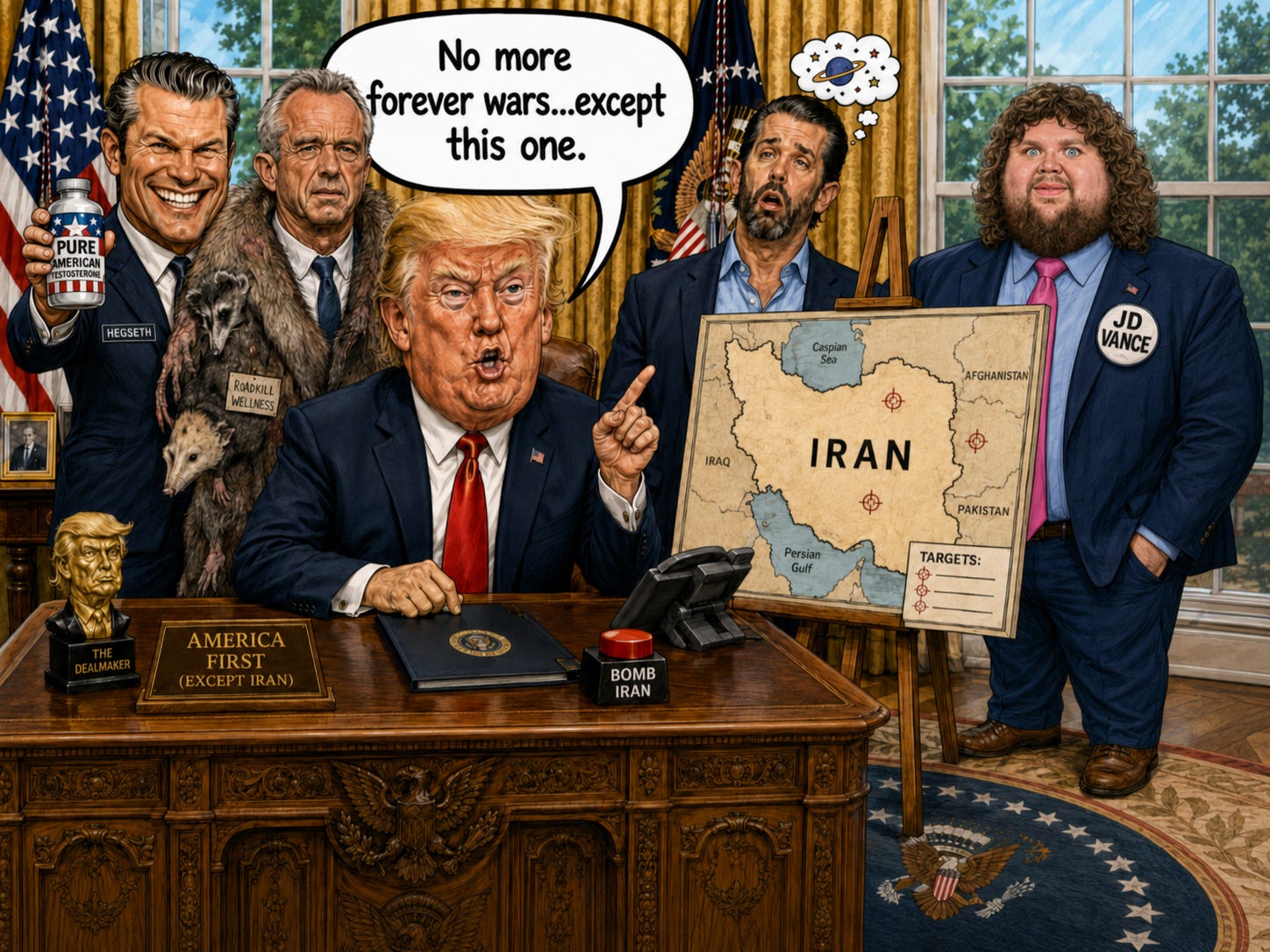
Trump's Forever War
The Iran War is starting to look like America's newest multigenerational conflict.
It took about two months to negotiate a page-and-a-half memorandum of understanding between the United States and Iran. It took three weeks for that understanding to fall apart completely. Ali Vaez, the Iran project director at the International Crisis Group, put it bluntly on CNN this week: if a minimal understanding like that can’t hold, there’s no floor left under this relationship, and we’re looking at one cycle of violence bleeding into the next. That’s the technical definition of a forever war, and it’s exactly where we are.
The timeline is worth laying out plainly, because the pace has been dizzying even by the standards of a Trump-era news cycle.
Early July: the ceasefire/MOU that took two months of diplomacy to build starts to unravel
Mid-July: the US launches what CENTCOM called a “major wave” of strikes, hitting roughly 140 Iranian military sites in a single overnight assault
Iran responds by striking US bases inside the territory of Arab allies, Qatar, Kuwait, and Bahrain among them, drawing furious condemnation from those governments
Trump reimposes a blockade on Iranian ports, and oil markets react accordingly, with Brent crude posting its biggest single-day jump in over six years
By mid-July, the US is running strikes on a near-daily basis, and Trump is publicly musing about hitting Iranian bridges and power plants if Tehran doesn’t come back to the table
You’ll notice that bridges and power plants are not shipping-lane targets. They’re civilian infrastructure, and floating them as options is how a “protect commercial traffic in the Strait of Hormuz” mission quietly becomes something much bigger. Regional analysts have already started reading the current targeting pattern (radar installations, naval facilities, logistics chokepoints) as evidence that Washington isn’t just trying to keep tankers moving anymore. It looks more like Washington has concluded that the only durable fix for the Strait of Hormuz problem is control of Iran’s southern coast. That is not a shipping-security objective, it’s a war aim in a war of conquest. It’s the kind of war that tends to arrive undeclared, backed into rather than voted on.1
The rhetoric coming out of Tehran has escalated right alongside it. An Iranian international relations analyst who has previously argued American regional bases are fair game named Kuwait as one of Iran’s top options for a ground incursion aimed at seizing the two US bases there. Iran’s former foreign minister, now a sitting member of parliament, went further on state media, floating a ground war to infiltrate and seize a US base and take American personnel hostage, conditioned on Washington seizing Iranian territory first. Neither of those is an official Tehran declaration of war. But when the range of publicly floated options widens from “strike allied bases” to “invade a Gulf monarchy and take hostages,” that’s not a sign either side is looking for the off-ramp.
We’ve watched this movie before. Iraq in 2003 was sold as disarmament and containment; within a year the stated mission had quietly become regime change and nation-building, with no serious accounting for how either was supposed to end. Afghanistan’s “degrade and disrupt” mandate against al-Qaeda outlived that objective by roughly two decades because nobody ever wrote down what victory looked like. The common thread isn’t incompetence, exactly. It’s that open-ended air campaigns are enormously easy to start and nearly impossible to stop, because de-escalating always looks like losing to whoever ordered the first strike.
Ironically, Trump used that very war Iraq as his reason for NOT wanting to start new wars.
Trump’s own rhetoric gives away how little strategic architecture is underneath any of this. Asked this week how long the strikes would continue, he told Fox News they’d go “until I say it’s enough.” That’s not a war aim. That’s a mood. Compare that with the branding Trump has built his second term around, ending wars, not starting them, and the dissonance gets hard to ignore. A president who spent years campaigning on getting America out of open-ended Middle East conflicts is currently running daily airstrikes with no stated endpoint and an ally-antagonizing footprint stretching across three additional countries.2
The economic exposure compounds by the week. Oil prices are still well below their earlier war-driven peaks, but they’re climbing again, and a sustained disruption to Hormuz oil traffic (through which a huge share of global crude transits) is inflationary in a way that hits American consumers whether or not they’ve been following the news out of the Gulf. Add in the reputational cost of watching Qatar, Kuwait, and Bahrain absorb Iranian retaliation for hosting American forces, and the price tag here isn’t just measured in strike sorties.3
The irony of Trump’s Iran adventure is that, more than once, Trump talked about how he would be the President who would “stop endless wars.” This wasn’t just something he campaigned on in 2024, but something he spoke about in his State of the Union address during his first term.
In 2024, he continued to hammer on the theme.
Which is why it becomes somewhat ironic that Trump, after a decade of discussing the end of “forever wars,” has launched the biggest American military quagmire since Vietnam.
None of this requires a verdict on whether the original strikes were justified to reach a simple conclusion: a war without a stated objective doesn’t end, it just continues at whatever intensity the last provocation demands. Trump inherited a fragile MOU, broke it, and has since offered nothing that resembles an exit condition, only escalation thresholds. If this keeps going the way the last two weeks have gone, “forever war” won’t be an analyst’s warning anymore. It’ll just be the accurate name for what Trump built.
Worth noting that the last administration to quietly redefine "protect shipping lanes" into "reshape the regime" did not, in fact, end up protecting shipping lanes any faster for it.
Anybody paying any attention to anything Trump has done during his two presidencies will not be surprised by this outcome.
The US will be paying the geopolitical and diplomatic price for this stupidity for fifty years.