

More than once, I have brought up Grover Norquist’s example that Republicans who vote for tax increases are the rat heads in the Coke Bottle.
Gallup released its annual read on Americans’ economic attitudes last week, and one number should make every Republican wince: 43% of Americans now have a positive view of socialism. That is the highest figure since the trend began in 2010, and the first time it has topped 39%.
Socialism still trails capitalism (55%) and free enterprise (77%), and Gallup is right that this is no wholesale stampede away from markets. But socialism now outpolls big business (35%), which would have gotten you laughed out of a Rotary Club in 1985.
The easy explanation is that Democrats did this. Their positive rating for socialism has climbed from 50% in 2010 to the mid-60s, and that story works fine for the last fifteen years. It does not explain this year. Democrats went from 66% to 65%. Republicans sit at 14%, unchanged. The entire increase came from independents, who jumped from 37% to 45% in twelve months.1
So who moved the independents? Well, he lives at 1600 Pennsylvania Avenue.
Consider what the Trump administration has actually done with the power of the state since the start of Trump’s second term (something I have been tracking since Day 1):
Ownership stakes. By Fortune’s count, roughly 30 equity or quasi-equity deals worth about $27 billion. The government holds 9.9% of Intel, converted from $8.9 billion in CHIPS Act money. The Pentagon holds an effective 15% of MP Materials, with a price floor on top. The president holds a “golden share” in U.S. Steel, which I broke down when the Nippon deal closed, plus stakes in lithium and mining companies. The full portfolio is in The Socialist Fox in the Henhouse, and the newer entries are in New Frontiers in MAGA Socialism.
Talk of taking a piece of AI. In June, Trump said he was exploring stakes in the big AI companies so the public shares in the upside.
Price controls. In January, Trump demanded a one-year, 10% cap on credit card interest, and asked from Davos, “Whatever happened to usury?”
Tariffs, then bailouts. Trumped taxes imports, then cuts checks to the farmers the trade war hurt: an $11 billion “bridge payment” announced in December, which I saw coming in MAGA’s Favorite Socialism Highlights a Bigger Conversation About Farm Subsidies. He has also floated $2,000 “tariff dividend” checks for households.
Nobody has to take my word for it. Conservative commentators said it about the credit card cap, and Speaker Mike Johnson felt obliged to argue that lenders would simply stop lending. When your own side is using the S-word about your president’s agenda, the word has stopped meaning what it used to.
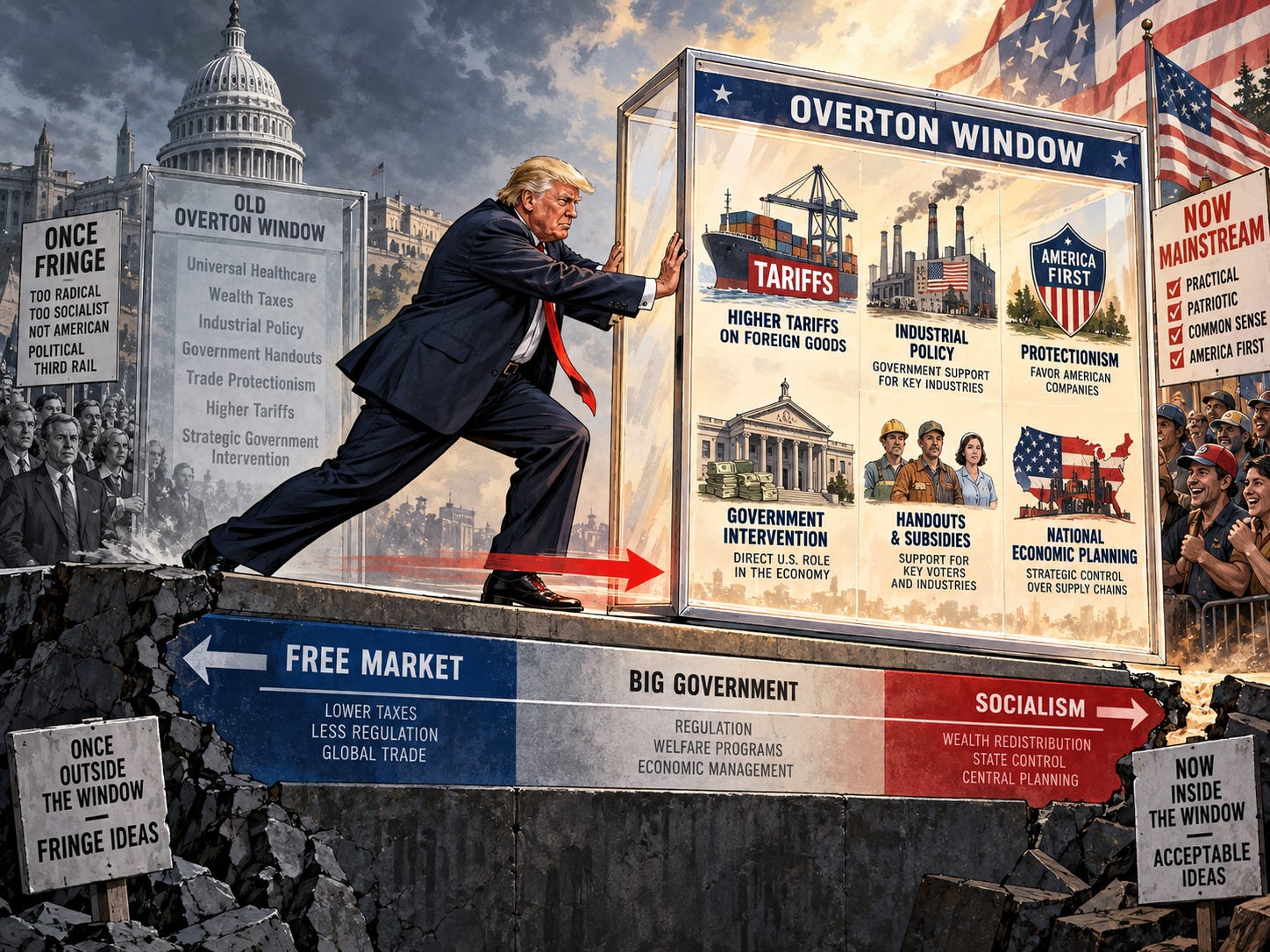
That’s the Overton Window moving, and it moved in two ways.
First, the state-ownership taboo is gone. For seventy years the Republican pitch was that government can’t pick winners, and that the only thing worse than the state running an industry was the state owning it. Now a Republican president owns the largest single stake in Intel, and the stock is up more than 300% since the first reports of the deal. The government’s slice was recently valued around $42 billion. Independents watched Washington take a stake in a company, watched the shares rip, and watched the sky stay exactly where it was. Try selling “government ownership is dangerous” after that.
Second, the word itself has been defused. Republicans spent a generation using “socialism” as an all-purpose slur, and the slur only works if it sticks to the other guy. Republican voters still hate the label (that 14% isn’t moving), but independents have no team to protect. They judge policies, not vocabulary, and the policies on offer come from the right side of the aisle.2 The one group the scare word was built to frighten is the one that stopped listening.
Gallup did not ask anyone why, and we can’t pretend a phone survey of 1,200 adults conducted in August proves causation. But the party that supposedly champions socialism gained nothing this year. Democrats were flat, and their numbers for capitalism (down to 35% from 42%) and free enterprise (65% from 73%) are still falling, but that is a long-running drift, not a new event. The only new movement came from the voters with no partisan reason to defend or attack the label, right after a Republican administration made state ownership a routine Tuesday.
The long game is worse for the GOP. Among adults 18 to 34, socialism now beats capitalism 57% to 43%. Among those 55 and older, capitalism wins 65% to 34%. Windows like this don’t slide back down when the president who opened them leaves office. The next Democratic nominee gets to point at Intel and say the government already does this, and I’d just do it for you.
The Republican Party spent decades teaching Americans to fear one word, then handed independents a working demonstration that they weren’t really that scared of socialism in the first place; they just wanted to be the socialists in charge. The Democratic Party gained exactly zero points on this poll, and didn’t even have to ask.
The last thing that America needs is socialist governance. But due to Donald Trump’s statist tendencies, he has led Republicans away from yet another of their core principles and made socialism more palatable to more people. That’s bad news for public policy, and bad news for America’s future.
I was told that if I didn't vote for Donald Trump, socialism would be imminent. And they were right.
The full sample carries a 4-point margin of error, and the independent subgroup is wider than that, so an eight-point swing could be partly noise. Independents also rated capitalism higher this year (56%, up from 51%), which suggests they aren't switching teams so much as losing interest in the old fight.
Economic nationalists will tell you it's Hamilton, political scientists will say "state capitalism," and any actual Marxist will point out that negotiating with Intel's CEO is not seizing the means of production. Voters don't sort it out that way, and neither do pollsters.