Not Just Canadian Bacon
Believe it or not, both the United States and Canada have already thought about what war with the other would look like
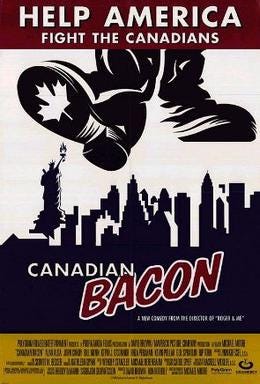
In the 1995 Michael Moore1 movie Canadian Bacon, a struggling U.S. President is persuaded by his advisors to get into a war with Canada.
In South Park: Bigger, Longer, & Uncut, the United States and Canada go to war over this children’s Television Show Terrance and Philip. Saddam Hussein and Satan are involved. The song “Blame Canada” was nominated for an Oscar for Best Original Song.
While those films were comedies, it’s no laughing matter anymore. As tensions escalate over the potential annexation of Greenland, the unthinkable has entered the halls of policy debate: the possibility of a real military rift between the United States and Canada. While modern observers might view this as a fever dream of 21st-century populism, military historians know that the blueprints for such a conflict have existed for over a century, long before Hollywood turned the idea into comedic fodder.
As idiotic as it is, we may be looking at war over Greenland.
To understand the strategic landscape of a modern Arctic war, we must look back to the interwar period, when two secret documents, Canada’s Defense Scheme No. 1 and the U.S. War Plan Red, defined the continental struggle for North America. These plans were not merely academic exercises; they were the desperate, logical conclusions of military minds grappling with the reality of geographic proximity and vastly unequal power.
Both plans are covered in the book War Plan Red: The United States’ Secret Plan to Invade Canada and Canada’s Secret Plan to Invade the United States.
The Quixotic Aggression: Defense Scheme No. 1 (1921)
In 1921, Lieutenant-Colonel James “Buster” Sutherland Brown, Canada’s Director of Military Operations and Intelligence, realized a terrifying truth: if the United States ever decided to invade Canada, the Canadian military would be crushed by sheer weight of numbers. Brown, a veteran of the First World War, understood that a static defense against an industrial giant was a death sentence.
Brown’s solution was not a passive defense, but a radical “forward defense.” Defense Scheme No. 1 proposed that the moment an American invasion seemed imminent, Canadian “flying columns” would launch a surprise preemptive strike into the northern United States.
The Pacific Push: Canadian troops would seize Seattle, Spokane, and Portland. The intent was to disrupt the rail hubs that would feed American reinforcements into British Columbia.
The Prairie Strike: Columns would dash for Fargo and Great Falls, advancing toward Minneapolis. By seizing the Midwest’s transit points, Brown hoped to paralyze the American mobilization engine.
The Eastern Front: Quebecois troops would occupy Albany, New York, while Maritime units would “reclaim” Maine. This was designed to create a buffer zone around the crucial St. Lawrence Seaway.
The goal wasn’t permanent occupation; it was chaos. By seizing American infrastructure and then retreating while blowing up bridges and railways, Brown hoped to buy enough time for the British Royal Navy to cross the Atlantic and save the Dominion. It was a “suicidal” gamble, but it reflected a core Canadian military tenet: sovereignty is maintained through delay and external alliance. Brown famously spent his vacations scouting the northern U.S. in civilian clothes, mapping out the very bridges his men would eventually destroy.
The Industrial Juggernaut: War Plan Red (1930)
While the Canadians were planning “zany” raids, the American military was approaching the problem with cold, industrial logic. Finalized in 1930 and updated through the mid-30s, War Plan Red was the U.S. contingency for a war with the British Empire (designated “Red”). Canada (designated “Crimson”) was the primary battlefield.
American planners in the War Department viewed Canada as the “hostage” of the British Empire. If London moved against American interests, Washington would strike at the nearest and most vulnerable part of the Crown. The American strategy was a mirror image of the Canadian fear:
The Seizure of Halifax: A massive amphibious assault to deny the British a port of entry. Without Halifax, the Royal Navy would have no viable base to launch a counter-offensive into North America. This was, arguably, the most important choke point for American forces to control.
The St. Lawrence Severance: Taking Montreal and Quebec City to split Canada in two and cut off the interior from the sea. Planners noted that once the St. Lawrence was controlled, the Canadian government would be functionally decapitated.
The Breadbasket Occupation: Moving from St. Paul into Winnipeg to control the rail lines and grain supplies. The goal was to starve the “Crimson” resistance and force an early surrender.
Unlike the Canadian plan, War Plan Red assumed a war of attrition and eventual annexation. American planners even considered the use of chemical weapons2 (specifically mustard gas) to break Canadian resistance in the urban centers of the East. The objective was simple: “Crimson” must be neutralized to prevent it from being used as a staging ground for “Red” (Britain). To the Americans, Canadian neutrality was a myth; Canada was either a partner or a target.
The current friction over Greenland mirrors the interwar anxieties of the 1920’s. Greenland is no longer just a frozen landmass; it is the “unsinkable aircraft carrier” of the Arctic, critical for ballistic missile defense, control of the Northwest Passage and full of rare earth minerals as I discussed earlier this week. If the U.S. moves to secure Greenland “the hard way,” it shatters NATO and effectively invalidates the North American Aerospace Defense Command (NORAD).
In a future conflict, the DNA of these old plans would inevitably resurface in military policy:
The Return of “Delay and Disrupt”: Canada still lacks the conventional mass to win a land war against the U.S. In a Greenland-triggered conflict, Canadian policy would likely revert to the spirit of Defense Scheme No. 1. That does not necessarily mean a U.S. invasion, but instead focusing on “asymmetric denial.” This would mean using the geography of the High North to make any U.S. movement through Canadian Arctic waters or territory prohibitively expensive in terms of time and logistics. Modern “flying columns” would likely be cyber-warfare units and special forces tasked with disabling American Arctic sensors and supply lines.
The Choke-Point Strategy: War Plan Red’s obsession with Halifax remains crucial. In a modern context, the “choke point” is the GIUK gap (Greenland-Iceland-UK) and the Northwest Passage. When Canada aligns with Denmark or the EU/NATO to protect Greenlandic self-determination, U.S. military policy would prioritize the “neutralization” of Canadian Arctic sensors and bases, such as CFS Alert. The U.S. would seek to ensure that no third party (be it the EU/NATO or Russia) could use Canadian waters to flank American defenses. U.S. Seizure of Halifax would be high on this list as well.
Strategic Autonomy vs. Continental Integration: For decades, Canada has relied on “Continental Defense”: the idea that defending North America is a joint venture. A war over Greenland forces Canada to choose between its sovereignty and its primary security partner. Just as Buster Brown sought British help, modern Canada would likely seek a “European Pivot.” Inviting EU, NATO or more specifically UK forces into the Arctic to counterbalance American hegemony would be a radical departure from the Ogdensburg Agreement of 1940. Such a move would trigger every “War Plan Red” instinct in Washington, leading to a policy of preemptive occupation to prevent “foreign” forces from gaining a foothold on the continent. It would also create a VERY awkward situation in the UK, where American forces are stationed on several Royal Air Force bases.
The stakes in the 21st century are arguably higher than they were in 1930. The melting ice has opened new shipping lanes and revealed vast mineral wealth, making the United Nations Convention on the Law of the Sea (UNCLOS) a central point of contention. Canada’s claim to the Northwest Passage as internal waters is directly challenged by the U.S. position that it is an international strait.
If the U.S. feels its access to Greenland or the Arctic is threatened by Canadian legal “obstruction,” the transition from cooperation to coercion could happen with alarming speed. Military policy would shift from shared surveillance to active monitoring of the “Crimson” neighbor. We would see a fortification of the 49th parallel not seen since the days of the Fenian Raids.
The “undefended border” is a historical luxury, not a geographic law. While Defense Scheme No. 1 and War Plan Red were shelved in favor of the post-WWII alliance, they represent the natural strategic reflexes of two nations that share a continent but have fundamentally different views of its future. Canada views the continent as a collection of sovereign entities protected by international law; the U.S. often views the continent as a single security perimeter that it alone must manage.
The Greenland crisis isn’t just about a large island; it’s about the fundamental breakdown of the “special relationship” between the United States and Canada and the United States and NATO. If Greenland becomes the flashpoint for a new Arctic Cold War, we should not be surprised if the “flying columns” and “Crimson” blockades return to the briefing rooms of Ottawa and D.C. History doesn’t repeat, but in the snowy expanses of the North, it certainly rhymes. The ghost of Buster Brown is still out there, mapping the bridges, waiting for a signal that the alliance has finally reached its breaking point.
Yeah, THAT Michael Moore
This plan became operational fifteen years before the Trinity Test. Chemical weapons were the biggest weapon of mass destruction around at that point.