

The Socialist Fox in the Henhouse
Republican paranoia about Democratic Socialism would be more believable if they cared about the socialism of the Trump Administration.

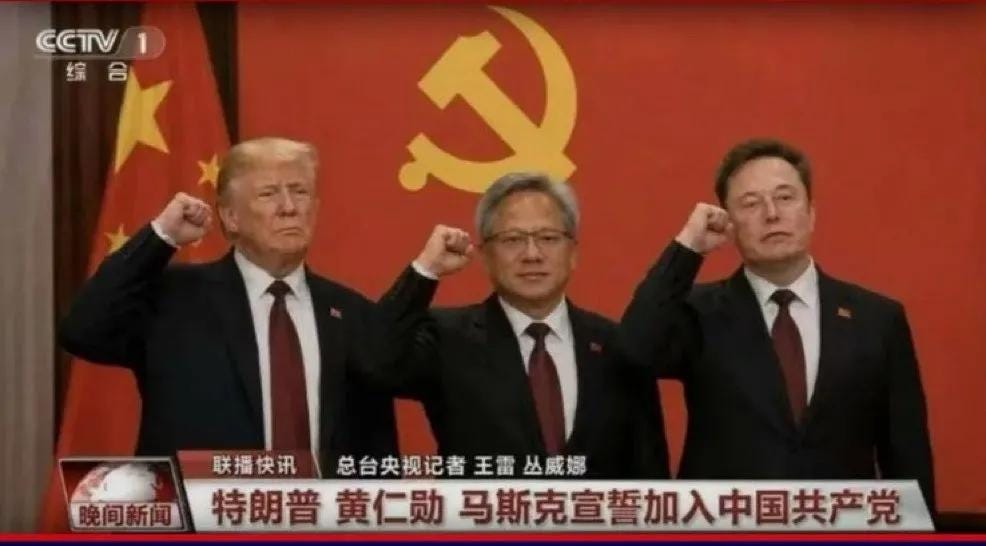
Mike Johnson stood in front of the RNC last week and warned that America is at a crossroads between “our status as a constitutional republic” and “this dark road of death to communism.” Lisa McClain followed up by describing a wave of “crazy little mini-Mamdani’s” as “a danger to you and your family.” The National Republican Congressional Committee has a memo. There is a battle plan. Zohran Mamdani, the Democratic Socialist Mayor of New York who wants the city to run its own grocery stores and freeze the rent, has become the organizing villain of the 2026 midterms.1
Meanwhile, the same administration warning you about the coming red dawn has spent the last year building the largest direct ownership stake in private industry that the U.S. government has held outside of a war or a financial crisis.
Thirty companies. Roughly $26.7 billion. Spanning semiconductors, rare earth mining, quantum computing, nuclear power, and rocket manufacturing. The Commerce Department owns a piece of Intel. The Department of War is the largest shareholder in a rare earth mining company. The Pentagon has a 40 percent stake in a Tennessee zinc smelter. The government negotiated a personal cut of Nvidia and AMD’s chip sales to China. And in the case of U.S. Steel, the president himself holds a “golden share” with veto power over the company’s capital spending, plant closures, and even its name, a mechanism I walked through in detail back when the Nippon deal closed.
Longtime readers know this isn’t a new observation for me. I’ve been tracking the MAGA drift toward federal handouts and bailouts for a while now, and the farm bailout money keeps flowing to the same voters who campaigned against socialism in the first place. The equity stakes portfolio is just the same instinct wearing a nicer suit.
Nobody in Republican leadership is calling this socialism. It isn’t, technically, and I want to be precise about why. Socialism, in the sense the GOP wants you to fear, means the state or the workers own the means of production and redirect the returns toward the public. What Trump is doing is closer to what political scientists call state capitalism, the model China and Russia run, where the government takes equity positions in strategic industries to direct them toward state priorities while private shareholders still collect most of the upside.2 It is a distinction with a difference. It is not a distinction that makes it good.
Here is the part that should actually worry you, and it isn’t the ideological label. It’s the mechanism. When the government owns 10 percent of Intel and simultaneously regulates Intel, sets its tariff exposure, and controls its export licenses, the normal incentive structure of a market economy breaks. Capital stops flowing to the best idea and starts flowing to the best government relationship. The MP Materials deal came with a guaranteed price floor for its products, which means the federal government has now put a thumb on the market price of rare earth magnets. The Nvidia and AMD arrangement means the U.S. Treasury now has a direct financial interest in maximizing chip sales to a strategic rival it claims to be racing against militarily. These are not the incentives of a functioning market. They are the incentives of a state that has decided winners in advance and is now managing its portfolio.
Democrats, to be clear, are not sitting this one out on principle. The same wave of DSA-aligned candidates that Mike Johnson wants you afraid of is running on public ownership of housing, municipal grocery stores, and public banking, all of which are, again, actual proposals for the state to own or directly manage productive assets.3 Mamdani’s own platform leans on city-run enterprise as a matter of ideology, not national security necessity. So you have one party building a shareholder position in Extropic and D-Wave Quantum under the banner of beating China, and the other party’s rising base explicitly campaigning on the idea that government ownership of core economic functions is a feature, not an emergency measure. Different vocabulary, same instinct: when markets produce outcomes you don’t like, take an equity stake and steer.
The reason this matters more than the usual hypocrisy call-out is that neither version of this is being run with any transparency or exit strategy. There is no consolidated public ledger of what the federal government owns. The 30 deals are scattered across four different agencies, seventeen through Commerce alone, with no unified reporting standard and no stated plan for when or whether the government sells its positions back to the market. A “sovereign wealth fund”, which is the polite term Treasury Secretary Scott Bessent has started using for this, at least in countries that run them well, comes with governance rules, transparency requirements, and a mandate. What we have instead is a series of ad hoc deals cut by whichever agency got there first, justified after the fact as national security, with veto power in at least one case handed to a single elected official and passed down like an heirloom to whoever holds the office next.
That’s the actual danger, and it has nothing to do with whether Zohran Mamdani wants the city to open a grocery store. A government that owns equity in the companies it regulates, taxes, and grants export licenses to has a built-in conflict of interest in every decision it makes about that industry going forward. It does not matter whether the hand on the wheel calls itself capitalist or socialist. The market stops being a market once the referee owns a piece in half of the teams.
The Democratic Socialism that is taking over the Democratic Party is plenty bad were it to be ushered into power in Washington. But that does not diminish the socialist-esque damage that the Trump Administration has done through market involvement and investment in private businesses.
Mike Johnson wants you looking at Queens. He should probably be looking at the Commerce Department’s cap table.4
Both lines are from Johnson and McClain's press availability ahead of the August recess, part of a coordinated House GOP messaging push tying Democratic primary wins to Mamdani and Bernie Sanders.
This is the framing used by trade researchers at the Cato Institute, not exactly a hotbed of socialist sympathy, which should tell you something about how uncontroversial the "state capitalism" label is among people who actually track this
DSA has actually been choosier than the "socialist takeover" narrative suggests. The group pulled its endorsement of AOC in 2024 over Israel policy, so even the "radicals" have internal purity tests Republicans aren't bothering to mention.
That would, of course, presuppose that Mike Johnson had the cojones to question the same President Donald Trump who he is dependent upon to keep his Speakership.